Trace the growth of Telugu Literature, Art and Architecture during the rule of Qutbshahis with suitable examples.
In short
Under the Qutbshahis, Telugu literature flourished through royal patronage of poets like Addanki Gangadhara, Ponnegenta Telaganaraya and Kshetrayya, alongside Bhakta Ramadas's Rama keerthanas, while Golconda textiles and Deccani art thrived. Architecture produced the Charminar (1591-92), Golconda Fort, the Qutb Shahi Tombs and the Mecca Masjid.
Model answer
Ghissu Editorial · Verified 4 Oct 2026 · 312 words
Royal Patronage
Ibrahim Quli and Muhammad Quli Qutbshahi supported Telugu poets like Addanki Gangadhara Kavi (*Thapathi Samvaranophakyanam*), promoting Telugu alongside Persian and Urdu. This patronage encouraged literary production and cultural synthesis in the Deccan.
‘Accha Telugu’ Style and Notable Poets
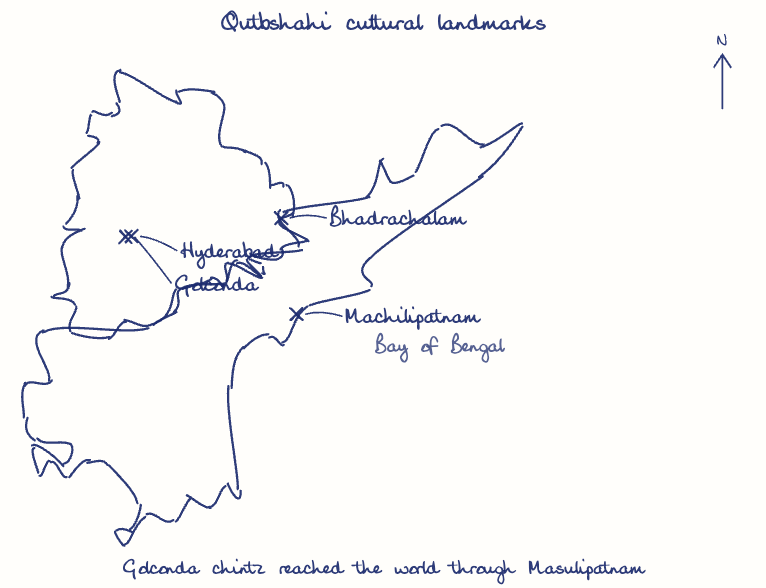
Ponnegenta Telaganaraya’s *Yayaticharitam* pioneered the refined ‘Accha Telugu’ literary style during this period. Additionally, poets like Saranga Thammaiah (*Vaijayanthi Vilasam*) and Kshetrayya, known for devotional ‘Padas’, flourished. Kancharla Gopanna (Bhakta Ramadas) composed devotional *Keerthanas* and built the Bhadrachalam temple, blending religious devotion with literary creativity.
Textile Trade and Economic Prosperity
Golconda textiles, especially muslins and chintz, thrived under royal kharkhanas, boosting economic and artistic prosperity. Trade flourished through ports like Masulipatnam, enhancing the region’s cultural and commercial significance.
Iconic Monuments
The Charminar (1591-92) stands as a masterpiece of Indo-Islamic architecture, symbolizing Hyderabad’s cultural apex and the Qutbshahi architectural legacy.
Religious and Syncretic Architecture
Kancharla Gopanna’s Bhadrachalam temple shows that Hindu temple building continued under Qutbshahi rule, reflecting the era’s cultural pluralism.
This model answer is indicative and the model can make mistakes; please verify key facts independently.
Practise this question
1Get the answer sheet
Sized for this question.
2Write your answer
Timed, by hand.
3Get it marked
Your score and what to fix.
This chapter in the exam
Medieval Telangana: Kakatiyas, Velamas, Qutub Shahis, Sammakka Sarakka3 questions
Asked in 2 of 2 sittings since 2016
Most tested: Qutub Shahi cultural contribution and composite culture
Question from the official TGPSC Group-I Mains 2016 paper. Answer written by Ghissu's engine and checked against our editorial standards. Found an error? Tell us and we correct it within 48 hours.