Examine how the Qutub Shahi rulers laid the foundations for the emergence of composite culture in Golconda. Elucidate with specific examples.
In short
The Qutub Shahis (1518-1687) built Golconda's composite culture through inclusive administration, patronage of Persian, Dakhini and Telugu literature, religious tolerance and Indo-Persian architecture. Examples include Hindu ministers Madanna and Akkanna, Muhammad Quli Qutb Shah's Charminar and Darush-Shifa, and royal grants to the Bhadrachalam temple.
Model answer
Ghissu Editorial · Verified 4 Oct 2026 · 272 words
Promotion of Multilingual Literature
Sultan Muhammad Quli Qutb Shah patronized Persian, Dakhini Urdu, and Telugu literature, fostering a shared cultural milieu. His own poetry in these languages encouraged a literary culture that blended Persian and local idioms, nurturing a composite linguistic identity.
Religious Tolerance and Syncretism
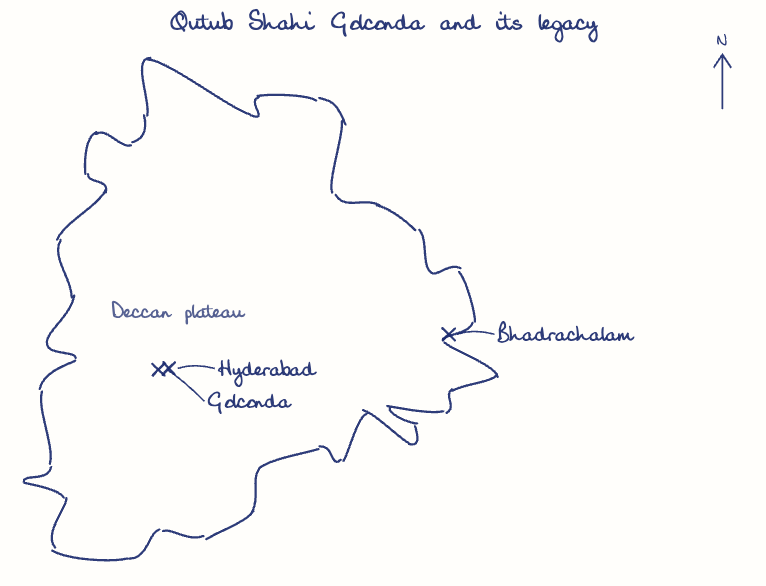
The rulers supported Hindu temples like Bhadrachalam Sri Rama Temple and allowed Hindu participation in Muharram, reflecting interfaith harmony and syncretic religious practices. Sufi traditions promoted universal brotherhood, further blending Islamic and Hindu spiritual traditions.
Architectural and Urban Synthesis
The Charminar and Qutub Shahi tombs blend Persian-Islamic and indigenous styles; Hyderabad’s city planning by Mir Momin Astarbadi integrated Persian garden layouts with local features. This architectural fusion symbolized the cultural amalgamation that defined Golconda’s identity.
Darush-Shifa Hospital
Founded by Muhammad Quli Qutb Shah, it combined Islamic Unani medicine with local healing, serving as a cultural and scientific hub that provided free treatment and education.
Religious Patronage
Sultan Abul Hasan’s donations to Hindu temples and construction of Ashurkhanas for Shia rituals illustrate support for diverse faiths, reinforcing the dynasty’s commitment to pluralism.
This model answer is indicative and the model can make mistakes; please verify key facts independently.
Sources
Practise this question
1Get the answer sheet
Sized for this question.
2Write your answer
Timed, by hand.
3Get it marked
Your score and what to fix.
This chapter in the exam
Medieval Telangana: Kakatiyas, Velamas, Qutub Shahis, Sammakka Sarakka3 questions
Asked in 2 of 2 sittings since 2016
Most tested: Qutub Shahi cultural contribution and composite culture
Question from the official TGPSC Group-I Mains 2024 paper. Answer written by Ghissu's engine and checked against our editorial standards. Found an error? Tell us and we correct it within 48 hours.