Write an essay on the growth of Buddhism and Buddist Art and Architecutre in Telangana region during the period of Satavahanas and Ikshvakus.
In short
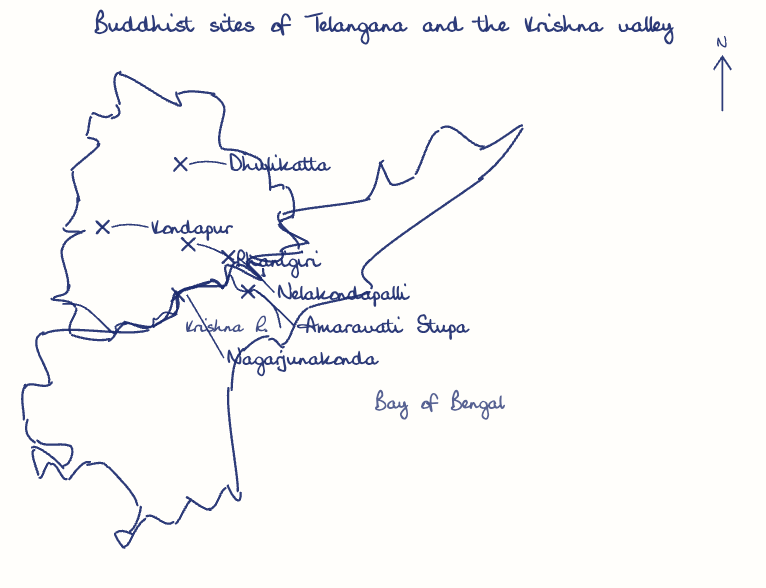
Under Satavahana patronage and Ikshvaku refinement, Buddhism flourished in the Telangana region through stupas, viharas and chaityas at Dhulikatta, Kondapur and Phanigiri, alongside Amaravati and Nagarjunakonda in the Krishna valley. The Amaravati school's narrative sculpture defined its art, and Phanigiri has yielded an inscription of Ikshvaku king Rudrapurushadatta.
Model answer
Ghissu Editorial · Verified 4 Oct 2026 · 276 words
Integration with Local Traditions
Buddhism assimilated local megalithic and tribal beliefs, aiding its acceptance among non-Aryan populations and fostering a syncretic religious culture in Telangana.
Ikshvaku Mahayana Influence
The Ikshvakus (3rd-4th century CE) advanced Buddhism by promoting Mahayana sects, while Sanskrit1 began to appear in later royal records, reflecting gradual Sanskritization, with Nagarjunakonda (now in Andhra Pradesh) and Phanigiri in Telangana flourishing as Buddhist centres.
Religious Pluralism and Decline
Despite Buddhist flourishing, Shaivism and Vaishnavism gained ground; Ikshvaku support for Hindu temples alongside Buddhist establishments and monastic corruption contributed to Buddhism’s gradual decline.
Amaravati School and Architectural Innovation
The Satavahana Amaravati school created fluid, ornate sculptures depicting Buddha’s life and Jataka tales, and constructed large stupas and rock-cut viharas, influencing Buddhist art across South Asia and Southeast Asia.
Ikshvaku Refinement and Transition
The Ikshvaku period refined Amaravati art with greater Sanskritic and Agama architectural principles, evident in brick temples and bathing ghats at Nagarjunakonda; however, the rise of Hindu temple architecture marked a shift from Buddhist motifs to Brahmanical themes.
Heritage Conservation
Strengthen preservation of Telangana sites such as Phanigiri and Dhulikatta, alongside Amaravati and Nagarjunakonda in Andhra Pradesh, through state initiatives and UNESCO collaboration to protect and promote the region’s Buddhist heritage.
This model answer is indicative and the model can make mistakes; please verify key facts independently.
Practise this question
1Get the answer sheet
Sized for this question.
2Write your answer
Timed, by hand.
3Get it marked
Your score and what to fix.
This chapter in the exam
Ancient Telangana: Satavahanas, Ikshvakus, Vishnukundins, Buddhism and Jainism3 questions
Asked in 2 of 2 sittings since 2016
Most tested: Satavahana–Ikshvaku cultural change in Telangana, especially Buddhism and literature.
Question from the official TGPSC Group-I Mains 2016 paper. Answer written by Ghissu's engine and checked against our editorial standards. Found an error? Tell us and we correct it within 48 hours.