Discuss if the right to vote is a statutory, constitutional or fundamental right.
In short
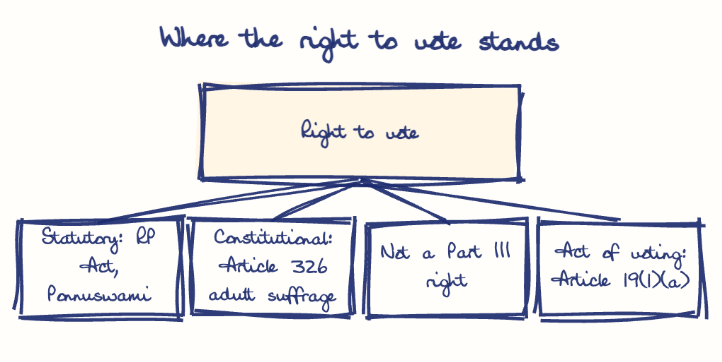
The right to vote is primarily a constitutional right under Article 326, which guarantees adult suffrage and is implemented through the Representation of the People Act, 1951, but it is not a fundamental right. PUCL (2003) called it constitutional, and voting itself is protected as expression under Article 19(1)(a).
Model answer
Ghissu Editorial · Verified 4 Oct 2026 · 272 words
Legislative Foundation
The Representation of the People Act, 1951 defines voter qualifications and procedures, making voting a statutory right.
Judicial Precedent
The Ponnuswami case (1952) held voting as a statutory right subject to legislative conditions.
Telangana Context
In Telangana, the Election Commission of India conducts Assembly polls under this Act, while the State Election Commission runs local body elections.
Constitutional Guarantee
Article 326 mandates universal adult suffrage for Lok Sabha and State Assemblies.
Judicial Clarification
Jyoti Basu v. Debi Ghosal (1982) called it a statutory right, but PUCL v. Union of India (2003) recognised voting as a constitutional right, though not fundamental.
Telangana’s Electoral Evolution
Since 2014, Telangana has upheld constitutional adult suffrage in state elections.
Not Fundamental per Se
Voting is not in Part III of the Constitution and lacks strict judicial protection.
Freedom of Expression Link
Voting is an expression protected under Article 19(1)(a).
Telangana Voter Education
Voter education initiatives in Telangana link voting with informed democratic participation.
Strengthen Voter Education
Expand awareness campaigns in Telangana using digital and local language tools.
Enhance Legal Safeguards
Amend laws to protect voting rights while respecting constitutional limits.
Institutional Reforms
Empower the Telangana State Election Commission with autonomy and resources.
This model answer is indicative and the model can make mistakes; please verify key facts independently.
Practise this question
1Get the answer sheet
Sized for this question.
2Write your answer
Timed, by hand.
3Get it marked
Your score and what to fix.
This chapter in the exam
Fundamental Rights, Directive Principles and Fundamental Duties5 questions
Asked in 2 of 2 sittings since 2016
Most tested: Interplay of rights, especially classification of constitutional entitlements and the FR–DPSP boundary.
- 2024Explain the significance of Fundamental Duties and how they are essential for the progress of the nation.
- 2016Discuss the scope of special provisions for Backward Classes and the test to determine Backward Classes. Discuss the difference in the scope of provisions under Articles 15(4) and 16 (4).
All 5 questions, sorted by sub-topic, with model answers and practice.
Question from the official TGPSC Group-I Mains 2016 paper. Answer written by Ghissu's engine and checked against our editorial standards. Found an error? Tell us and we correct it within 48 hours.