Discuss the scope of special provisions for Backward Classes and the test to determine Backward Classes. Discuss the difference in the scope of provisions under Articles 15(4) and 16 (4).
In short
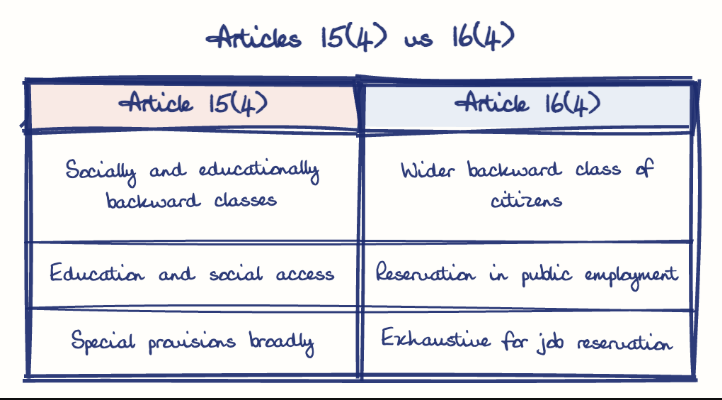
Special provisions for backward classes cover reservations in education, jobs and legislatures, identified by an empirical test of social backwardness and bound by Indra Sawhney's creamy layer and 50% ceiling. Article 15(4) covers socially and educationally backward classes in education, while Article 16(4) covers any backward class in public employment.
Model answer
Ghissu Editorial · Verified 4 Oct 2026 · 366 words
Implementation Examples
Telangana’s BC-A to BC-E categorisation and its 2024 caste survey illustrate empirical identification of backward classes for state reservations, linking constitutional provisions to policy. Proposals to raise BC quotas beyond the 50% ceiling, however, face judicial scrutiny.
Judicial Criteria
The Supreme Court’s triple test in K. Krishnamurthy (2010) and Vikas Kishanrao Gawali (2021), and Indra Sawhney (1992) before it, require empirical commission reports (e.g., Kalelkar, Mandal, Backward Classes Commission1) to identify backwardness, emphasizing social and educational factors over pure economic status.
Broader Coverage under Article 16(4)
Article 16(4) includes SCs, STs, OBCs, and other backward groups, allowing wider reservation in public employment than Article 15(4). This broader scope permits inclusion of groups not covered under Article 15(4).
Distinct Language and Focus
Article 15(4) targets “socially and educationally backward classes” for education and social access; Article 16(4) uses “backward class of citizens” broadly for public employment reservation. This reflects their different functional domains.
Judicial Interpretation
Courts affirm Article 16(4) as exhaustive for employment reservations but allow other affirmative actions under Article 16(1); Article 15(4) is more restrictive and focused on social and educational upliftment.
This model answer is indicative and the model can make mistakes; please verify key facts independently.
Practise this question
1Get the answer sheet
Sized for this question.
2Write your answer
Timed, by hand.
3Get it marked
Your score and what to fix.
This chapter in the exam
Fundamental Rights, Directive Principles and Fundamental Duties5 questions
Asked in 2 of 2 sittings since 2016
Most tested: Interplay of rights, especially classification of constitutional entitlements and the FR–DPSP boundary.
- 2024Explain the significance of Fundamental Duties and how they are essential for the progress of the nation.
- 2016Discuss if the right to vote is a statutory, constitutional or fundamental right.
All 5 questions, sorted by sub-topic, with model answers and practice.
Question from the official TGPSC Group-I Mains 2016 paper. Answer written by Ghissu's engine and checked against our editorial standards. Found an error? Tell us and we correct it within 48 hours.