Discuss the Right to legal aid and whether it is a Fundamental Right or a Directive Principle of State Policy.
In short
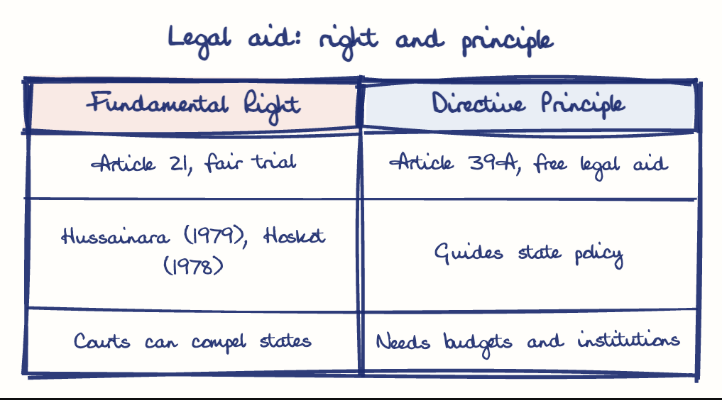
The right to legal aid ensures the poor are not denied justice for lack of money, and it is both a fundamental right, read into Article 21 in Hussainara Khatoon (1979), and a Directive Principle under Article 39A. The Legal Services Authorities Act, 1987 delivers it through NALSA.
Model answer
Ghissu Editorial · Verified 4 Oct 2026 · 252 words
Judicial Recognition
The Supreme Court in Hussainara Khatoon v. State of Bihar (1979) expanded Article 21 to include legal aid as essential for a fair trial.
Institutional Framework
The Legal Services Authorities Act, 1987, established NALSA and Telangana State Legal Services Authority, facilitating free legal services and Lok Adalats1.
Fundamental Right Basis
Judicial rulings like M.H. Hoskot v. State of Maharashtra (1978) affirm legal aid as part of the right to life and liberty under Article 21, making it justiciable.
Directive Principle Aspect
Article 39A mandates free legal aid as a state policy, non-justiciable but guiding governance. This duality balances enforceability and aspirational goals.
Enforceability and Oversight
As a Fundamental Right, courts can compel states to provide legal aid, strengthening rule of law and protecting vulnerable litigants.
Policy and Resources
Directive Principles require state commitment, reflected in NALSA funding and the Legal Aid Defence Counsel System (2022), supporting legal empowerment.
Social Inclusion
Legal aid promotes equity, supporting marginalized groups like women, Scheduled Castes, Scheduled Tribes, and persons in custody, who are entitled to free legal aid under Section 12 of the 1987 Act.
State Variations
Implementation varies; Telangana’s proactive legal services authority exemplifies positive state action overcoming Directive Principles’ non-justiciability challenges.
This model answer is indicative and the model can make mistakes; please verify key facts independently.
Sources
Practise this question
1Get the answer sheet
Sized for this question.
2Write your answer
Timed, by hand.
3Get it marked
Your score and what to fix.
This chapter in the exam
Fundamental Rights, Directive Principles and Fundamental Duties5 questions
Asked in 2 of 2 sittings since 2016
Most tested: Interplay of rights, especially classification of constitutional entitlements and the FR–DPSP boundary.
- 2024Explain the significance of Fundamental Duties and how they are essential for the progress of the nation.
- 2016Discuss if the right to vote is a statutory, constitutional or fundamental right.
All 5 questions, sorted by sub-topic, with model answers and practice.
Question from the official TGPSC Group-I Mains 2016 paper. Answer written by Ghissu's engine and checked against our editorial standards. Found an error? Tell us and we correct it within 48 hours.