Explain the salient features of inclusive growth strategy of Twelfth Five Year Plan.
In short
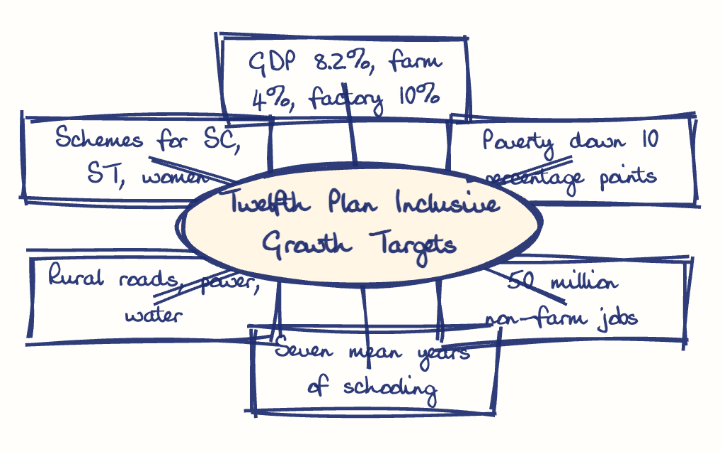
The Twelfth Plan (2012-17) pursued inclusive growth by combining high growth with jobs, skills, education, health, rural infrastructure and targeted welfare for marginalised groups. It targeted 8.2% GDP growth, 4% in agriculture, 10% in manufacturing, 50 million non-farm jobs and a 10-point fall in poverty.
Model answer
Ghissu Editorial · Verified 4 Oct 2026 · 264 words
Balanced sectoral growth targets
Set 8.2% GDP growth, with 4% in agriculture and 10% in manufacturing, to stimulate rural and urban economies. This dual focus was intended to generate employment and raise incomes across sectors.
Poverty reduction and employment
Targeted a 10-point drop in poverty and 50 million new non-farm jobs, supported by skill certification to improve employability. The Plan emphasized skill development aligned with industry needs to enhance job quality and access.
Rural infrastructure and services
Enhanced rural connectivity and water supply through PMGSY roads and the National Rural Drinking Water Programme, reducing regional disparities. Telangana’s Mission Bhagiratha and Mission Kakatiya later extended drinking water and tank irrigation, raising rural incomes.
Targeted support for marginalized groups
The National Rural Livelihoods Mission (2011) and the Scheduled Castes and Tribal Sub-Plans empowered SC/ST/OBC, women and minorities. Telangana’s 12.4%3 budget allocation exemplifies focused welfare, helping close historical social and economic gaps.
Promote inclusive education and rural development
Implement outcome-based education reforms targeting marginalized groups and increase investment in rural infrastructure to improve livelihoods and reduce disparities.
This model answer is indicative and the model can make mistakes; please verify key facts independently.
Practise this question
1Get the answer sheet
Sized for this question.
2Write your answer
Timed, by hand.
3Get it marked
Your score and what to fix.
This chapter in the exam
Planning, NITI Aayog, liberalisation5 questions
Asked in 2 of 2 sittings since 2016
Most tested: Planning era performance and the shift from Planning Commission to NITI Aayog
- 2024How far has India achieved the policy target of doubling the farmers' income by 2022? Examine.
- 2024"Replacement of the Planning Commission by NITI Aayog has changed the approach to development planning in India." Explain.
All 5 questions, sorted by sub-topic, with model answers and practice.
Question from the official TGPSC Group-I Mains 2016 paper. Answer written by Ghissu's engine and checked against our editorial standards. Found an error? Tell us and we correct it within 48 hours.