"Replacement of the Planning Commission by NITI Aayog has changed the approach to development planning in India." Explain.
In short
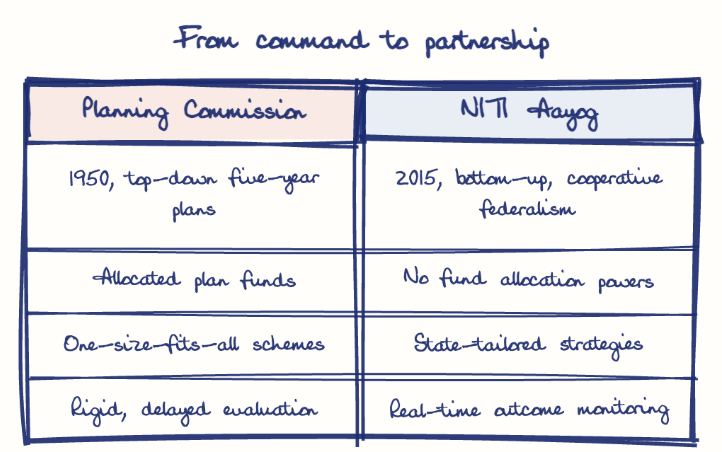
Replacing the Planning Commission with NITI Aayog in 2015 shifted Indian planning from a centralised, top-down, one-size-fits-all model to cooperative federalism, with states as equal partners. NITI Aayog works as a think tank without fund-allocation powers, using data-driven indices and programmes like the Aspirational Districts Programme.
Model answer
Ghissu Editorial · Verified 4 Oct 2026 · 254 words
Centralized Command Model
Established in 1950, the Planning Commission formulated five-year plans and allocated resources centrally, often ignoring state-specific needs and causing fiscal tensions, as seen in Telangana’s post-statehood challenges.
Criticisms
It was criticized for bureaucratic rigidity and political influence, failing to adapt to India’s evolving economic landscape.
Policy Think Tank and Collaborative Platform
NITI Aayog promotes cooperative federalism by involving states2 as partners, providing strategic advice and data-driven tools like the Fiscal Health Index3, and coordinating initiatives such as the Aspirational Districts Programme targeting underdeveloped areas including Telangana.
Flexible Structure and Fiscal Decentralization
As a non-statutory body without fund allocation powers, it encourages states’ fiscal autonomy and innovation, exemplified by schemes like the Atal Innovation Mission.
From Centralized to Cooperative Federalism
The shift empowers states to design context-specific strategies, with Telangana leveraging Mission Kakatiya and Mission Bhagiratha under NITI’s framework.
Data-Driven and Inclusive Growth
Emphasis on real-time data and outcome-oriented programs enhances transparency and addresses regional disparities at district and block levels.
Capacity Building and Monitoring
Strengthening state capacities and expanding data-driven monitoring will ensure adaptive and effective planning.
This model answer is indicative and the model can make mistakes; please verify key facts independently.
Practise this question
1Get the answer sheet
Sized for this question.
2Write your answer
Timed, by hand.
3Get it marked
Your score and what to fix.
This chapter in the exam
Planning, NITI Aayog, liberalisation5 questions
Asked in 2 of 2 sittings since 2016
Most tested: Planning era performance and the shift from Planning Commission to NITI Aayog
- 2024How far has India achieved the policy target of doubling the farmers' income by 2022? Examine.
- 2016Critically appraise the objectives and major achievements in Indian economy during the Planning era during 1950-91.
All 5 questions, sorted by sub-topic, with model answers and practice.
Question from the official TGPSC Group-I Mains 2024 paper. Answer written by Ghissu's engine and checked against our editorial standards. Found an error? Tell us and we correct it within 48 hours.