"Institutional credit to agricultural sector has become inequitous in the State". Describe the nature of the inequality.
In short
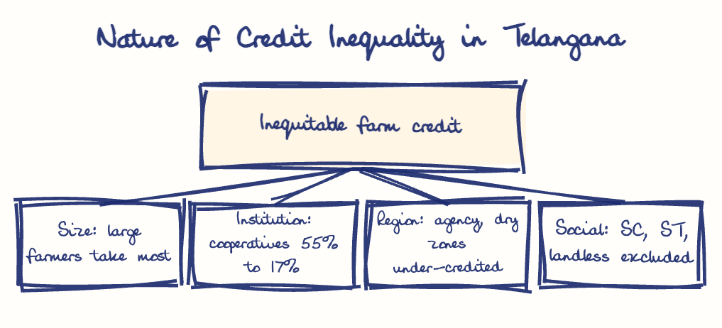
Institutional agricultural credit in Telangana is skewed by landholding, region, institution and social group: large farmers gain most, while tenants, SCs, STs and dry and agency areas are under-served. The cooperative share of rural credit fell from 55% in the 1980s to about 17%, pushing small farmers towards moneylenders.
Model answer
Ghissu Editorial · Verified 4 Oct 2026 · 261 words
Decline of Cooperative Banks
Their share dropped from 55% in the 1980s to 17%, limiting affordable credit for vulnerable groups.
Urban Bank Dominance and Regional Gaps
Commercial banks provide over 70% of credit, concentrated in urban areas, neglecting rain-fed and agency tracts.
Seasonal and Regional Skew
Agency and dry zones in Telangana face under-crediting, deepening regional disparities.
Collateral and Land Ownership
Tenant farmers and landless labourers are excluded due to collateral requirements.
Risk Aversion and Institutional Weakness
Banks avoid lending to smallholders due to production risks; cooperative banks’ decline and limited RRB outreach worsen access.
Political Capture
Credit diversion by affluent farmers through collusion with officials excludes vulnerable groups, as seen in Telangana.
Marginal Farmer Distress
Dependence on informal lenders leads to indebtedness and suicides in districts like Warangal and Adilabad.
Regional Development Gaps
Under-crediting limits investment in irrigation and technology in tribal and dry areas.
Social Exclusion
Scheduled Castes, Tribes, and landless labourers remain marginalized from formal credit.
Revitalise Cooperatives and RRBs
Expand affordable credit in underserved Telangana regions.
Expand Kisan Credit Card1
Focus on tenant farmers and women to reduce informal borrowing.
Link Credit with Insurance
Mitigate risks to encourage lending in vulnerable areas.
This model answer is indicative and the model can make mistakes; please verify key facts independently.
Sources
Practise this question
1Get the answer sheet
Sized for this question.
2Write your answer
Timed, by hand.
3Get it marked
Your score and what to fix.
This chapter in the exam
Agriculture and allied sectors in Telangana7 questions
Asked in 2 of 2 sittings since 2016
Most tested: Irrigation and institutional agricultural credit, especially their regional inequality and policy role in Telangana.
- 2024"Irrigation plays a crucial role in Telangana's agricultural growth and food security." Justify this in the context of sustained initiatives of the state government.
- 2024"Timely and adequate availability of institutional agricultural credit to a large extent determines the production and productivity of crops." Comment.
All 7 questions, sorted by sub-topic, with model answers and practice.
Question from the official TGPSC Group-I Mains 2016 paper. Answer written by Ghissu's engine and checked against our editorial standards. Found an error? Tell us and we correct it within 48 hours.