"Timely and adequate availability of institutional agricultural credit to a large extent determines the production and productivity of crops." Comment.
In short
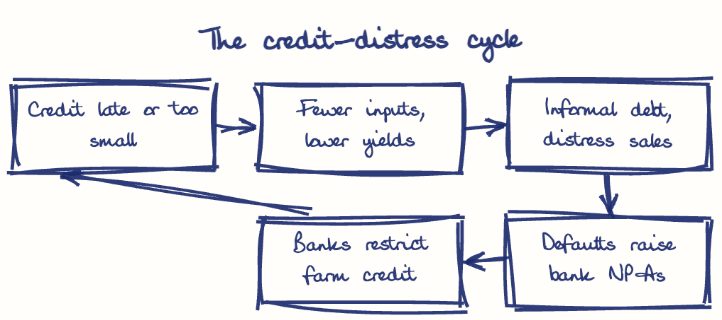
Timely and adequate institutional credit largely determines crop output by funding quality inputs and technology before sowing and keeping farmers away from costly informal lenders. A NABARD study found 40% of farmers got loans too small for farm expenses, which Telangana's crop loan waiver and Rythu Bharosa seek to address.
Model answer
Ghissu Editorial · Verified 4 Oct 2026 · 229 words
Synchronising Credit with Crop Cycles
Timely credit before sowing is vital; delays reduce effectiveness. NABARD found 40% of farmers receive inadequate loans, limiting input use. Additionally, delayed disbursal often forces farmers to rely on costly informal credit during critical periods.
Rising NPAs and Credit Disparities
Defaults increase NPAs, restricting credit flow; regional disparities widen productivity gaps. Small farmers and certain regions receive disproportionately less institutional credit, exacerbating inequality.
Expand Credit Schemes
Increasing collateral-free loan limits and expanding Kisan Credit Card coverage will improve adequacy. Integrating credit with extension services and insurance will enhance utilisation efficiency.
This model answer is indicative and the model can make mistakes; please verify key facts independently.
Practise this question
1Get the answer sheet
Sized for this question.
2Write your answer
Timed, by hand.
3Get it marked
Your score and what to fix.
This chapter in the exam
Agriculture and allied sectors in Telangana7 questions
Asked in 2 of 2 sittings since 2016
Most tested: Irrigation and institutional agricultural credit, especially their regional inequality and policy role in Telangana.
- 2024"Irrigation plays a crucial role in Telangana's agricultural growth and food security." Justify this in the context of sustained initiatives of the state government.
- 2016"Institutional credit to agricultural sector has become inequitous in the State". Describe the nature of the inequality.
All 7 questions, sorted by sub-topic, with model answers and practice.
Question from the official TGPSC Group-I Mains 2024 paper. Answer written by Ghissu's engine and checked against our editorial standards. Found an error? Tell us and we correct it within 48 hours.