What are the effective strategies for the removal of poverty? What is the experience of different anti-poverty programmes in India?
In short
Poverty falls fastest when inclusive growth, employment guarantees, financial inclusion and social protection work together, and MGNREGA, NRLM, PDS and PMAY show both gains and gaps in funding and delivery. Multidimensional poverty fell from 29.17% in 2013-14 to 11.28% in 2022-23, and Telangana's SERP mobilised lakhs of women into SHGs.
Model answer
Ghissu Editorial · Verified 4 Oct 2026 · 263 words
Employment Guarantee and Livelihood Support
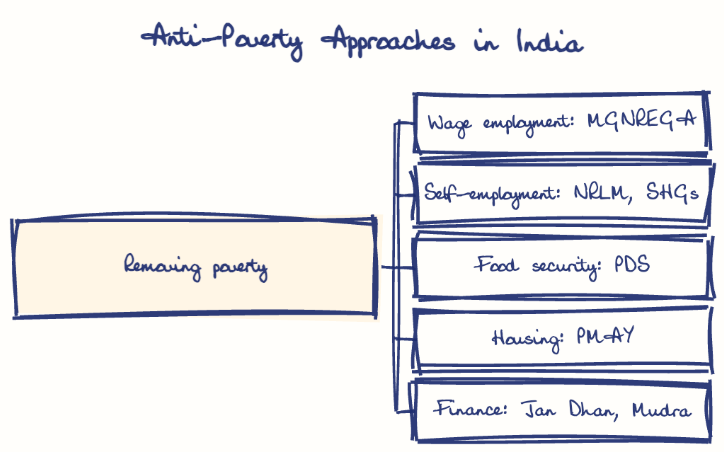
MGNREGA ensures 100 days of rural wage employment; Telangana’s social audits and NGO collaborations have enhanced transparency and impact. This scheme also creates durable rural assets, improving long-term livelihoods.
Financial Inclusion and Credit Access
Pradhan Mantri Mudra Yojana and Telangana’s DBT welfare and Rythu Bandhu schemes have expanded credit access and reduced farmer indebtedness. The Pradhan Mantri Jan Dhan3 Yojana has further integrated the poor into the formal banking system.
Women Empowerment and Skill Development
Telangana’s Society for Elimination of Rural Poverty (SERP) mobilizes women into SHGs under NRLM, improving economic status and social empowerment. Skill India Digital Platform and Skill India International Centers (SIIC) enhance employability, especially for youth and women, addressing structural unemployment.
Housing and Urban Poverty Alleviation
PM Awas Yojana Gramin and urban slum redevelopment in Hyderabad improve living conditions for the poor by providing affordable housing and basic amenities, reducing urban homelessness and vulnerability.
Employment Linked Incentive Scheme
Scaling vocational training and employment linkages can boost youth and women’s job prospects, helping break the poverty cycle through sustainable livelihoods.
This model answer is indicative and the model can make mistakes; please verify key facts independently.
Practise this question
1Get the answer sheet
Sized for this question.
2Write your answer
Timed, by hand.
3Get it marked
Your score and what to fix.
This chapter in the exam
Poverty and unemployment4 questions
Asked in 2 of 2 sittings since 2016
Most tested: Anti-poverty programmes and poverty measurement/comparison
- 2024"Human Poverty Index and capability approach are two ways to understand and measure poverty and well- being of people." Explain in brief.
- 2024"Poverty reduction in different states of India has not been uniform during the post-economic reform period." Examine.
All 4 questions, sorted by sub-topic, with model answers and practice.
Question from the official TGPSC Group-I Mains 2016 paper. Answer written by Ghissu's engine and checked against our editorial standards. Found an error? Tell us and we correct it within 48 hours.