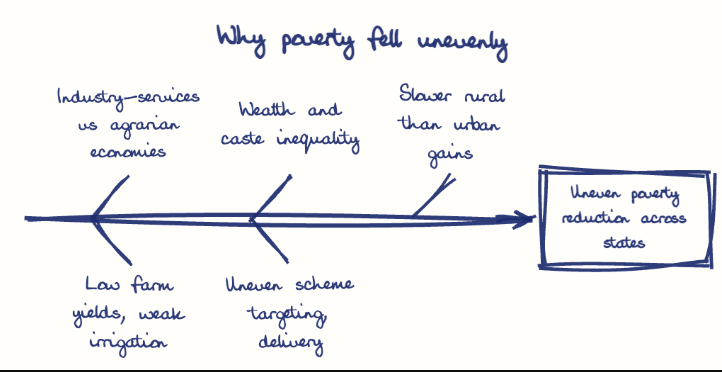
"Poverty reduction in different states of India has not been uniform during the post-economic reform period." Examine.
In short
Post-reform poverty reduction has been real but uneven, shaped by each state's economic structure, agricultural productivity, inequality and quality of governance. Multidimensional poverty fell from 29.17% to 11.28% between 2013-14 and 2022-23, with Telangana and Uttar Pradesh progressing faster while Bihar and Jharkhand lagged.
Model answer
Ghissu Editorial · Verified 4 Oct 2026 · 264 words
Governance and Welfare
Telangana’s 12.4%5 welfare allocation for SC/ST/OBC and schemes like Rythu Bandhu demonstrate effective policy targeting aiding poverty reduction. Additionally, states with weak implementation and poor targeting have lagged behind.
Human Development
Telangana’s education (9.0%) and health (4.8%) spending supports capability building essential for sustainable poverty alleviation.
Labour Market
Telangana’s 60.7% labour force participation rate vs national 55.8% improves employment opportunities. Formalisation of jobs and urban infrastructure like Hyderabad’s HITEC City also contribute to poverty reduction.
Inclusive Growth
Skill development via the Skill India Digital Platform and schemes like the Employment Linked Incentive (ELI) can create quality jobs, while expanding social protection schemes will ensure vulnerable groups benefit.
This model answer is indicative and the model can make mistakes; please verify key facts independently.
Practise this question
1Get the answer sheet
Sized for this question.
2Write your answer
Timed, by hand.
3Get it marked
Your score and what to fix.
This chapter in the exam
Poverty and unemployment4 questions
Asked in 2 of 2 sittings since 2016
Most tested: Anti-poverty programmes and poverty measurement/comparison
- 2024"Human Poverty Index and capability approach are two ways to understand and measure poverty and well- being of people." Explain in brief.
- 2016What are the effective strategies for the removal of poverty? What is the experience of different anti-poverty programmes in India?
All 4 questions, sorted by sub-topic, with model answers and practice.
Question from the official TGPSC Group-I Mains 2024 paper. Answer written by Ghissu's engine and checked against our editorial standards. Found an error? Tell us and we correct it within 48 hours.