Define plant tissue culture. Explain the importance of tissue culture in Agriculture.
In short
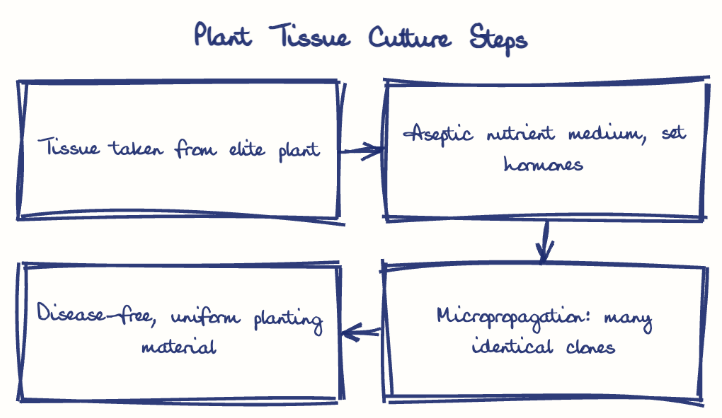
Plant tissue culture is the aseptic growth of plant cells, tissues or organs on a nutrient medium under controlled conditions, including micropropagation of identical plants. In agriculture it yields disease-free planting material for potato and sugarcane, rapid multiplication of elite varieties like banana, germplasm conservation and support for genetic engineering.
Model answer
Ghissu Editorial · Verified 4 Oct 2026 · 246 words
Aseptic Cultivation
It involves sterile growth of plant cells, tissues, or organs in nutrient media, allowing precise control over growth factors and enabling micropropagation for clonal plant multiplication. This sterile environment prevents microbial contamination, ensuring healthy plantlets.
Disease-Free Plant Production
Meristem culture produces virus-free plants critical for crops like potato and sugarcane; Telangana's extension services promote clean planting material to boost horticulture. This enhances crop health and yield by reducing pathogen load.
Rapid Multiplication and Germplasm Conservation
Micropropagation accelerates elite cultivar production (e.g., banana, sugarcane) and enables in vitro germplasm conservation, aiding biodiversity and breeding. It also allows easy exchange of genetic material with minimal quarantine restrictions.
Infrastructure and Integration
Expand tissue culture labs and Micropropagation Technology Parks and link with molecular breeding to develop resilient varieties suited to Telangana’s agro-climatic conditions.
Farmer Awareness and Partnerships
Promote adoption through farmer extension programs and foster public-private partnerships for cost-effective scaling of tissue culture propagation and commercialization.
This model answer is indicative and the model can make mistakes; please verify key facts independently.
Sources
Practise this question
1Get the answer sheet
Sized for this question.
2Write your answer
Timed, by hand.
3Get it marked
Your score and what to fix.
This chapter in the exam
Biotechnology, genetic engineering, stem cells6 questions
Asked in 2 of 2 sittings since 2016
Most tested: Applied biotechnology in human health and agriculture, especially genetic engineering/biotech applications.
- 2024Genetic engineering has led to break through in various research areas in solving health issues. Highlight importance of genetic engineering in stem cell manipulation towards its application in regenerative medicine.
- 2024Conversion of crop residues to bio-fuel is a potential method to reduce air pollution. Discuss.
All 6 questions, sorted by sub-topic, with model answers and practice.
Question from the official TGPSC Group-I Mains 2016 paper. Answer written by Ghissu's engine and checked against our editorial standards. Found an error? Tell us and we correct it within 48 hours.