Conversion of crop residues to bio-fuel is a potential method to reduce air pollution. Discuss.
In short
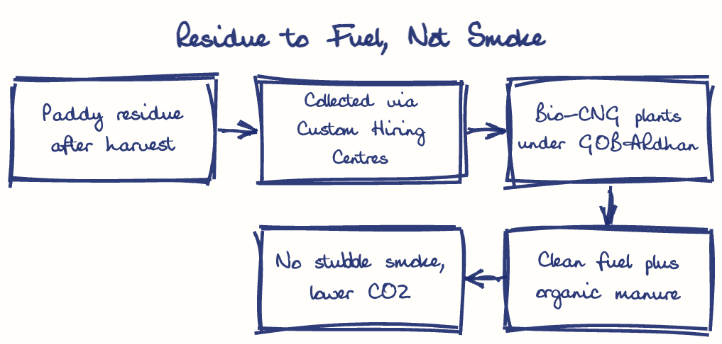
Converting crop residues into biofuels such as bio-CNG turns a pollutant into clean energy, cutting stubble burning and its air pollution while adding farm income and improving soils. Bio-CNG from residues can prevent about 20 million tonnes of CO2 a year, though machinery costs and supply-chain gaps slow adoption.
Model answer
Ghissu Editorial · Verified 4 Oct 2026 · 270 words
Government Initiatives
The Crop Residue Management scheme (2018) targets key states with subsidies for machinery and bio-decomposers; ₹10,000 crore under GOBARdhan funds 500 bio-CNG plants, fostering a waste-to-wealth shift1. Additionally, over 40,000 Custom Hiring Centres distribute more than 295,000 CRM machines, improving farmer access to technology.
Judicial Directives
Hon'ble NGT OA No. 1016/20192 (17.02.2021) and Hon'ble Supreme Court WP(C) No. 13029 of 1985 (03.04.2025) enforce residue use in industries and curb stubble burning, though enforcement gaps persist. Mandatory use of paddy straw biomass in NCR brick kilns exemplifies judicial efforts to reduce pollution.
Environmental Impact
Bio-CNG production reduces ~20 million tonnes CO₂ annually; bio-decomposer sprays convert stubble into manure, cutting chemical fertiliser use by 20-30%, enhancing soil health. Crop residues also offer industrial uses in paper and textiles, providing farmers additional income of Rs. 3,000-5,000 per acre.
Policy Integration
Mandating biomass use in brick kilns per NGT orders and promoting co-ownership of machinery can improve residue management. Integrating crop residue use into industrial policies will create steady demand and reduce burning.
This model answer is indicative and the model can make mistakes; please verify key facts independently.
Practise this question
1Get the answer sheet
Sized for this question.
2Write your answer
Timed, by hand.
3Get it marked
Your score and what to fix.
This chapter in the exam
Biotechnology, genetic engineering, stem cells6 questions
Asked in 2 of 2 sittings since 2016
Most tested: Applied biotechnology in human health and agriculture, especially genetic engineering/biotech applications.
- 2024Genetic engineering has led to break through in various research areas in solving health issues. Highlight importance of genetic engineering in stem cell manipulation towards its application in regenerative medicine.
- 2016What is pharmacogenomics? Discuss the important applications of biotechnology in human health.
All 6 questions, sorted by sub-topic, with model answers and practice.
Question from the official TGPSC Group-I Mains 2024 paper. Answer written by Ghissu's engine and checked against our editorial standards. Found an error? Tell us and we correct it within 48 hours.