Discuss the important shifts in the trajectory of policies on science and technology in India since Independence.
In short
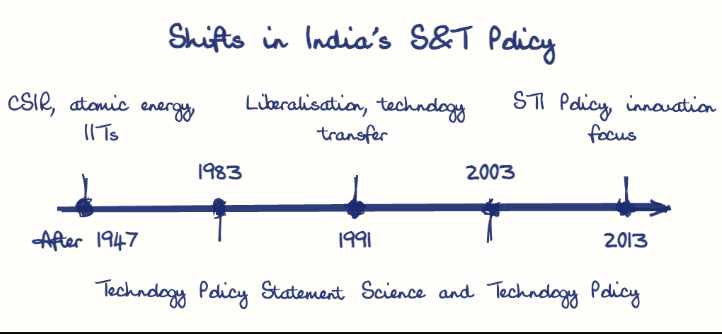
India's science and technology policy moved from post-1947 institution building (CSIR, DAE) to self-reliance under the 1983 Technology Policy Statement, then to globally integrated innovation after 1991. R&D-led policies in 2003 and 2013 and the Digital India push followed, though R&D spending stays near 0.65% of GDP.
Model answer
Ghissu Editorial · Verified 4 Oct 2026 · 272 words
1983 Technology Policy2
Marked a shift to indigenous technology development, reducing foreign dependence, especially in electronics and defence.
Post-1991 Liberalization
Opened markets, encouraged private sector and foreign collaboration, exemplified by Hyderabad’s HITEC City as an IT innovation hub.
2000s Innovation Focus
National Science and Technology Policy (2003) and STI Policy (2013) increased R&D funding and academia-industry partnerships.
Digital and Manufacturing Drive
Digital India and Make in India initiatives boosted digital infrastructure and domestic manufacturing, with Telangana leading in IT and pharmaceuticals.
Institutional and Talent Growth
Early investments enabled ISRO’s space success and nuclear tests in 1998, showcasing strategic autonomy.
Innovation Ecosystem Expansion
Liberalization fostered biotech hubs like Hyderabad’s Genome Valley, enhancing global competitiveness.
R&D Investment Challenges
India’s R&D expenditure remains low at around 0.65% of GDP, slowing commercialisation of research.
Digital Inclusion and Governance
Digital India improved services in Telangana via platforms like MeeSeva and T-Fiber, but digital divides persist.
Strategic Global Engagement
Joining MTCR in 2016 and global commons governance reflects India’s rising technological stature.
Increase R&D Funding
Aim for 2% of GDP, supporting clusters like those in Telangana.
Strengthen Innovation Ecosystems
Enhance academia-industry links and startup incubation using models like HITEC City and Genome Valley.
Promote Responsible Digital Inclusion
Expand infrastructure while addressing regulatory and ethical challenges.
This model answer is indicative and the model can make mistakes; please verify key facts independently.
Practise this question
1Get the answer sheet
Sized for this question.
2Write your answer
Timed, by hand.
3Get it marked
Your score and what to fix.
This chapter in the exam
S&T policy, technology missions, ICT, robotics, nanotechnology7 questions
Asked in 2 of 2 sittings since 2016
Most tested: Policy frameworks and governance of science and technology, especially ICT-led inclusion and emerging-tech applications.
- 2024The nano-technology, an advanced technology is gaining attention for futuristic solutions for several problems. Describe its scope and usage for providing solution for the problems related to environment.
- 2024The National strategy for robotics aims to position India as a global leader in robotics to actualize its transformative potential. Elaborate the main focus areas for robotic automation in India.
All 7 questions, sorted by sub-topic, with model answers and practice.
Question from the official TGPSC Group-I Mains 2016 paper. Answer written by Ghissu's engine and checked against our editorial standards. Found an error? Tell us and we correct it within 48 hours.