Explain the salient features of Indian Science, Technology and Innovation Policy 2013.
In short
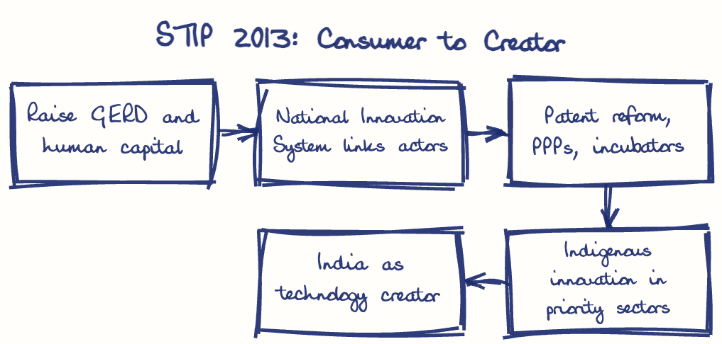
STIP 2013 aimed to turn India from a technology consumer into a technology creator through innovation-led growth, higher R&D investment, stronger human capital and focus on agriculture, health, energy and IT. It proposed a National Innovation System, patent reforms, public-private R&D partnerships and technology clusters and incubators.
Model answer
Ghissu Editorial · Verified 4 Oct 2026 · 261 words
Strengthening Human Capital
The policy also focused on developing skilled human resources in science and technology by improving education and training to address the shortage of qualified researchers.
National Innovation System2
STIP 2013 proposed a robust framework integrating research institutions, universities, industry, and government agencies to foster collaboration.
Public-Private Partnerships
The policy introduced incentives and grants to boost private sector R&D, recognizing its key role in manufacturing innovation.
Boosting Indigenous Innovation
The policy aimed to reduce dependence on foreign technology and position India as a global innovation hub.
Regional Innovation Hubs
Telangana’s HITEC City and IIIT-H exemplify the policy’s impact in fostering vibrant startup ecosystems and technology-driven growth.
Economic and Social Development
Targeted S&T interventions in sectors like agriculture and health were designed to promote inclusive growth.
Promote Regional Innovation
Supporting technology clusters in states like Telangana can decentralize innovation and leverage local strengths.
Expand Skill Development Programs
Scaling initiatives like Atal Tinkering Labs will build a larger pool of skilled researchers and entrepreneurs.
This model answer is indicative and the model can make mistakes; please verify key facts independently.
Practise this question
1Get the answer sheet
Sized for this question.
2Write your answer
Timed, by hand.
3Get it marked
Your score and what to fix.
This chapter in the exam
S&T policy, technology missions, ICT, robotics, nanotechnology7 questions
Asked in 2 of 2 sittings since 2016
Most tested: Policy frameworks and governance of science and technology, especially ICT-led inclusion and emerging-tech applications.
- 2024The nano-technology, an advanced technology is gaining attention for futuristic solutions for several problems. Describe its scope and usage for providing solution for the problems related to environment.
- 2024The National strategy for robotics aims to position India as a global leader in robotics to actualize its transformative potential. Elaborate the main focus areas for robotic automation in India.
All 7 questions, sorted by sub-topic, with model answers and practice.
Question from the official TGPSC Group-I Mains 2016 paper. Answer written by Ghissu's engine and checked against our editorial standards. Found an error? Tell us and we correct it within 48 hours.