What is digital divide? Discuss the strategies to overcome the problems associated with digital divide.
In short
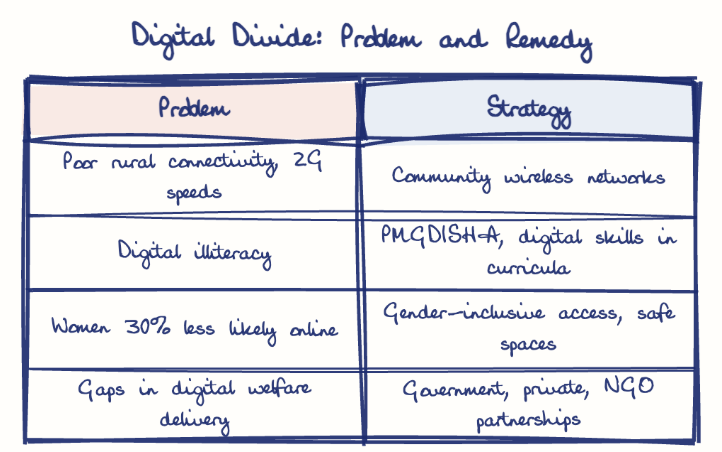
The digital divide is the gap between those who have access to digital technologies, connectivity and skills and those who do not, running along urban-rural, income and gender lines. Overcoming it needs affordable rural broadband, digital literacy drives like PMGDISHA, gender-inclusive policies and public-private partnerships.
Model answer
Ghissu Editorial · Verified 4 Oct 2026 · 272 words
Gendered Digital Divide1
Women are 30% less likely to use mobile internet; rural women’s access is only 28%, driven by patriarchal family norms and digital violence restricting digital citizenship. This gap limits women’s empowerment and participation in the digital economy.
Governance Gaps
Rural areas lag in accessing e-governance services; in Telangana, rural households have less easy access to online services and grievance redress than urban ones. This disparity reduces transparency and efficiency in public service delivery for rural populations.
Infrastructure Development
Telangana’s T-Fiber and BharatNet rural broadband projects expand affordable, high-speed internet to bridge gaps. Community wireless networks and improved broadband infrastructure are vital to connect remote areas.
Digital Literacy and Gender-Inclusive Policies
PMGDISHA certifies millions in digital skills; targeted interventions address women’s access and combat digital violence. Integrating digital skills into school curricula and teacher training ensures sustainable digital competence.
Public-Private Partnerships
Collaboration with EdTech and NGOs enhances rural digital education and cyber awareness. Such partnerships pool resources and foster innovation to reach marginalized communities effectively.
This model answer is indicative and the model can make mistakes; please verify key facts independently.
Sources
Practise this question
1Get the answer sheet
Sized for this question.
2Write your answer
Timed, by hand.
3Get it marked
Your score and what to fix.
This chapter in the exam
S&T policy, technology missions, ICT, robotics, nanotechnology7 questions
Asked in 2 of 2 sittings since 2016
Most tested: Policy frameworks and governance of science and technology, especially ICT-led inclusion and emerging-tech applications.
- 2024The nano-technology, an advanced technology is gaining attention for futuristic solutions for several problems. Describe its scope and usage for providing solution for the problems related to environment.
- 2024The National strategy for robotics aims to position India as a global leader in robotics to actualize its transformative potential. Elaborate the main focus areas for robotic automation in India.
All 7 questions, sorted by sub-topic, with model answers and practice.
Question from the official TGPSC Group-I Mains 2016 paper. Answer written by Ghissu's engine and checked against our editorial standards. Found an error? Tell us and we correct it within 48 hours.