What is meant by ICTs? Do ICTs enable break the existing social structural barriers? Explain.
In short
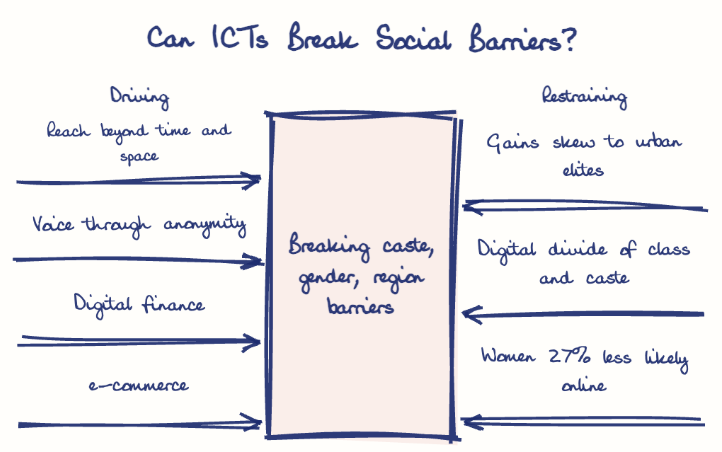
ICTs are digital technologies such as the internet, mobile phones, computers and broadcasting that create, store and exchange information. They can weaken, but not by themselves dismantle, barriers of gender, caste and region, since women in India are 27% less likely than men to access the internet.
Model answer
Ghissu Editorial · Verified 4 Oct 2026 · 273 words
Comprehensive ICT Components
ICTs include hardware, software, and infrastructure enabling communication; India’s optical fibre network grew from 19.35 lakh to 42.36 lakh route km by 2025, with data costs reduced to ₹8-10 per GB, enhancing accessibility nationwide.
Overcoming Constraints
ICTs minimize time and space barriers, empowering marginalized groups, especially women, to access education and markets remotely, overcoming traditional mobility restrictions.
Governance and Economic Empowerment
Digital platforms like Telangana’s Rythu Bandhu transfers and MeeSeva services enhance transparency and direct benefit transfers, reducing intermediaries and empowering beneficiaries economically and socially.
Structural Limitations
Despite potential, socio-cultural norms and digital literacy gaps limit ICTs’ reach; women are 27% less likely to access the internet, with gendered digital violence and unequal access persisting as major challenges.
Partial Disruption and Reinforcement
ICTs create new social spaces challenging traditional hierarchies but often benefit urban elites, while digital divides along class, caste, and gender lines reinforce existing inequalities.
Inclusive Design and Regulation
For transformative impact, ICTs must be inclusive and embedded in equitable regulatory frameworks, involving both genders in awareness and empowerment to ensure broad-based benefits.
Telangana’s Digital Initiatives
Targeted digital literacy and e-governance efforts in Telangana illustrate how focused interventions can leverage ICTs to reduce social barriers and promote inclusive development.
This model answer is indicative and the model can make mistakes; please verify key facts independently.
Practise this question
1Get the answer sheet
Sized for this question.
2Write your answer
Timed, by hand.
3Get it marked
Your score and what to fix.
This chapter in the exam
S&T policy, technology missions, ICT, robotics, nanotechnology7 questions
Asked in 2 of 2 sittings since 2016
Most tested: Policy frameworks and governance of science and technology, especially ICT-led inclusion and emerging-tech applications.
- 2024The nano-technology, an advanced technology is gaining attention for futuristic solutions for several problems. Describe its scope and usage for providing solution for the problems related to environment.
- 2024The National strategy for robotics aims to position India as a global leader in robotics to actualize its transformative potential. Elaborate the main focus areas for robotic automation in India.
All 7 questions, sorted by sub-topic, with model answers and practice.
Question from the official TGPSC Group-I Mains 2016 paper. Answer written by Ghissu's engine and checked against our editorial standards. Found an error? Tell us and we correct it within 48 hours.