Write a critical essay on the use of animals in laboratories.
In short
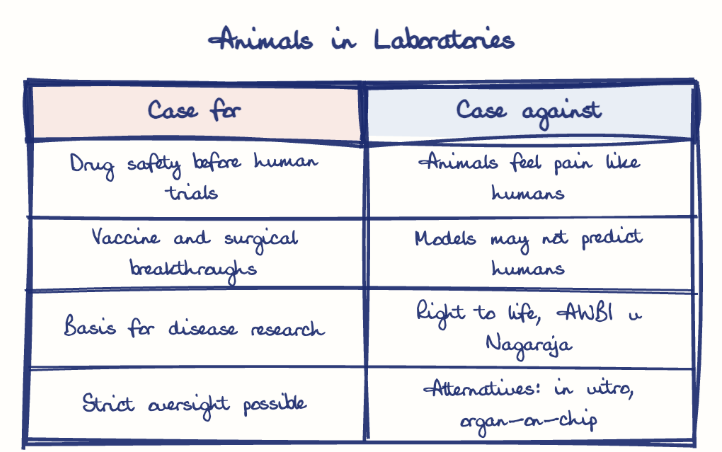
Animal research remains necessary for safe drug development and medical breakthroughs, but animals feel pain, so its moral cost is real, and animal models do not always predict human responses. The Prevention of Cruelty to Animals Act, 1960, CPCSEA and animal ethics committees regulate it, while the 3Rs push alternatives.
Model answer
Ghissu Editorial · Verified 4 Oct 2026 · 251 words
Judicial Safeguards
The Animal Welfare Board of India1 and the 2014 Supreme Court ruling in Animal Welfare Board of India v. A. Nagaraja emphasize animals’ right to life and minimizing cruelty in experiments. These legal protections mandate strict oversight to prevent unnecessary suffering in laboratories.
Moral Status
Neuroscientific findings on animal pain challenge past views, raising ethical dilemmas about causing suffering for human benefit. Robert Sapolsky’s research on primates highlights animals’ capacity for pain and distress, urging reconsideration of their treatment in experiments.
Drug Development
Animal testing remains essential for preclinical safety and efficacy, with Indian and Telangana institutions adhering to biosafety guidelines and ethical oversight. Institutional Animal Ethics Committees under CPCSEA guidelines ensure responsible research, crucial for developing treatments for diseases prevalent in the region.
Ethical and Regulatory Hurdles
The Prevention of Cruelty to Animals Act and AWBI guidelines impose necessary but resource-intensive restrictions. Ensuring minimal pain and distress requires rigorous monitoring, which can slow research but is vital for humane treatment.
This model answer is indicative and the model can make mistakes; please verify key facts independently.
Sources
Practise this question
1Get the answer sheet
Sized for this question.
2Write your answer
Timed, by hand.
3Get it marked
Your score and what to fix.
This chapter in the exam
Biotechnology, genetic engineering, stem cells6 questions
Asked in 2 of 2 sittings since 2016
Most tested: Applied biotechnology in human health and agriculture, especially genetic engineering/biotech applications.
- 2024Genetic engineering has led to break through in various research areas in solving health issues. Highlight importance of genetic engineering in stem cell manipulation towards its application in regenerative medicine.
- 2024Conversion of crop residues to bio-fuel is a potential method to reduce air pollution. Discuss.
All 6 questions, sorted by sub-topic, with model answers and practice.
Question from the official TGPSC Group-I Mains 2016 paper. Answer written by Ghissu's engine and checked against our editorial standards. Found an error? Tell us and we correct it within 48 hours.