Analyse briefly various schemes initiated by the Centre and State Governments for the welfare of senior citizens.
In short
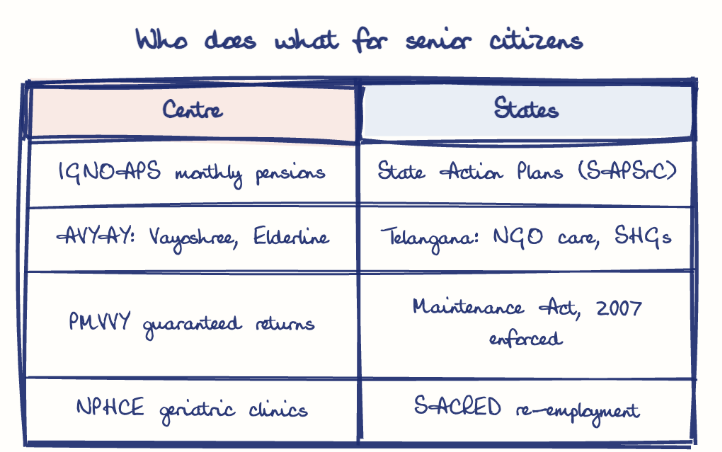
Central schemes for senior citizens include NSAP pensions under IGNOAPS, the Atal Vayo Abhyudaya Yojana, PMVVY and NPHCE geriatric care, backed by the 2007 Maintenance and Welfare of Parents and Senior Citizens Act. Telangana's Aasara pension tops up IGNOAPS to 2,016 rupees a month, though low awareness limits impact.
Model answer
Ghissu Editorial · Verified 4 Oct 2026 · 272 words
State Action Plans and Telangana
States design SAPSrC under central guidance to tailor welfare measures; Telangana tops up IGNOAPS through its Aasara pensions (₹2,016 a month) and promotes elderly care through NGOs under IPSRC, encouraging self-help groups to enhance social participation and economic activity.
Legal and Livelihood Measures
States enforce the Maintenance and Welfare of Parents and Senior Citizens Act, 2007, ensuring legal protection, and run programs like Senior Able Citizens for Re-employment and Dignity (SACRED) to provide employment and skill development opportunities for the elderly.
Low Awareness and Insufficient Pensions
Only 18% of eligible elderly access pensions, according to a UNFPA survey; pension amounts are often inadequate to meet basic needs, limiting poverty alleviation impact.
Human Resource and Service Fragmentation
There is a shortage of over 10 million trained caregivers, impeding quality elderly care; fragmented service delivery among government, NGOs, and private providers causes coordination challenges, necessitating stronger integration and regulatory frameworks.
This model answer is indicative and the model can make mistakes; please verify key facts independently.
Practise this question
1Get the answer sheet
Sized for this question.
2Write your answer
Timed, by hand.
3Get it marked
Your score and what to fix.
This chapter in the exam
Social policies and welfare programmes in India and Telangana3 questions
Asked in 1 of 2 sittings since 2016
Most tested: Contemporary welfare schemes and policy implementation, especially Centre-State scheme convergence.
- 2024Policy on Education is essential for Nation's growth. Discuss how the National Education Policy, 2020 can be implemented to meet the requirements of education in India.
- 2024Ayushman Bharat Digital Mission (ABDM) aims to provide digital health IDs for all Indian citizens to help hospitals, insurance firms and citizens access health records electronically when required. Discuss.
Question from the official TGPSC Group-I Mains 2024 paper. Answer written by Ghissu's engine and checked against our editorial standards. Found an error? Tell us and we correct it within 48 hours.