Discuss the role and functions of the National Commission for Scheduled Tribes.
In short
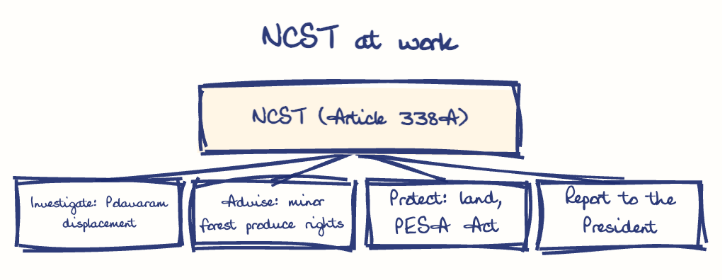
The National Commission for Scheduled Tribes, created under Article 338A by the 89th Amendment (2003), uses civil court powers to investigate complaints, monitor tribal safeguards, advise on ST policy and report to the President. It matters in Telangana's agency areas like Khammam and Adilabad, though vacancies weaken it.
Model answer
Ghissu Editorial · Verified 4 Oct 2026 · 287 words
Composition and Advisory Role
Comprising a Chairperson and members appointed by the President, it advises Union and State governments on policies affecting Scheduled Tribes, though consultation is often irregular. The Chairperson holds Cabinet Minister rank, enhancing its policy influence.
Investigative and Protective Functions
NCST investigates complaints, monitors safeguards, and promotes laws like the Panchayats (Extension to Scheduled Areas) Act, 1996, preventing land alienation and advocating sustainable livelihoods. It has intervened in cases such as the Polavaram Project evictions, ensuring rehabilitation.
Empowerment and Regional Significance
The Commission strengthens enforcement of tribal rights, notably in Telangana, complementing Tribal Sub-Plan allocations and the 2023 podu land titles under the Forest Rights Act to address displacement and welfare. Its role complements state efforts in tribal agency areas.
Operational Challenges
Delays in appointments, vacancies, and budget constraints hinder NCST’s effectiveness, with all key posts vacant as of early 2024. Political interference and limited parliamentary discussion further reduce its impact.
This model answer is indicative and the model can make mistakes; please verify key facts independently.
Practise this question
1Get the answer sheet
Sized for this question.
2Write your answer
Timed, by hand.
3Get it marked
Your score and what to fix.
This chapter in the exam
Social exclusion and vulnerable groups2 questions
Asked in 1 of 2 sittings since 2016
Most tested: Scheduled Tribes and the institutional response to social exclusion
Question from the official TGPSC Group-I Mains 2024 paper. Answer written by Ghissu's engine and checked against our editorial standards. Found an error? Tell us and we correct it within 48 hours.