Discuss briefly the nature and types of social exclusion that persist among the vulnerable groups in India.
In short
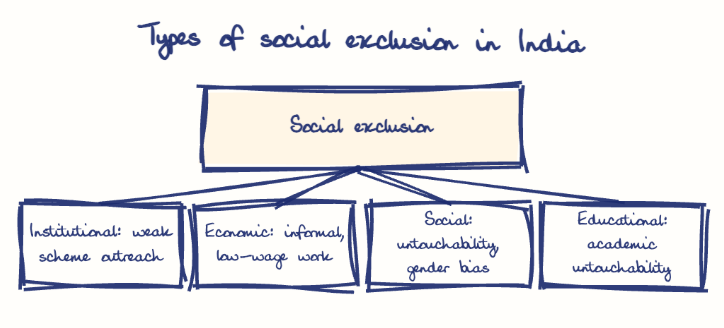
Social exclusion of SCs, STs, women, minorities and informal workers in India is institutional, economic, social and educational, from weak scheme delivery and informal jobs to caste and gender stigma and academic untouchability. In Telangana, only 3% of construction establishments are registered under the BOCW Act.
Model answer
Ghissu Editorial · Verified 4 Oct 2026 · 341 words
Constitutional Safeguards and Gaps
Articles 14, 15, and 17 protect against discrimination, but Dalits and tribals still face systemic exclusion; the 1950 Presidential Order under Article 341 limits SC status to Hindus, Sikhs and Buddhists, excluding Dalit Christians and Muslims.
Policy and Administrative Challenges
Telangana’s 3% registration of construction establishments under BOCW Act highlights poor outreach and limits formal protections for informal workers.
Social Justice Institutions
The Ministry of Social Justice & Empowerment’s efforts are constrained by limited resources, affecting marginalized groups including denotified tribes and transgender persons.
Educational Exclusion
Academic untouchability and harassment in higher education2 perpetuate exclusion and limit upward mobility.
Wealth Inequality and Informality
The top 10% control ~77% of national wealth; informal sector workers, especially women, face wage gaps and lack social security.
Multidimensional Poverty
Scheduled Castes, Tribes, and minorities suffer poor health, education, and living standards, reinforcing exclusion.
Social Stigma and Discrimination
Caste-based untouchability and gender bias restrict access to land, justice, and digital resources.
Intersectional Vulnerabilities
Overlapping identities deepen systemic barriers, requiring holistic, intersectional empowerment policies.
Poor Targeting and Delivery
Welfare schemes often miss beneficiaries due to exclusion errors and digital divides, especially in rural and tribal areas.
Economic Formalisation
Expanding registration and social security in sectors like construction can reduce economic exclusion.
Addressing Social Attitudes
Sustained awareness campaigns are needed to combat caste and gender discrimination.
This model answer is indicative and the model can make mistakes; please verify key facts independently.
Practise this question
1Get the answer sheet
Sized for this question.
2Write your answer
Timed, by hand.
3Get it marked
Your score and what to fix.
This chapter in the exam
Social exclusion and vulnerable groups2 questions
Asked in 1 of 2 sittings since 2016
Most tested: Scheduled Tribes and the institutional response to social exclusion
Question from the official TGPSC Group-I Mains 2024 paper. Answer written by Ghissu's engine and checked against our editorial standards. Found an error? Tell us and we correct it within 48 hours.