'The emergence of regional parties in India has been a significant development in its democratic journey.' Discuss.
In short
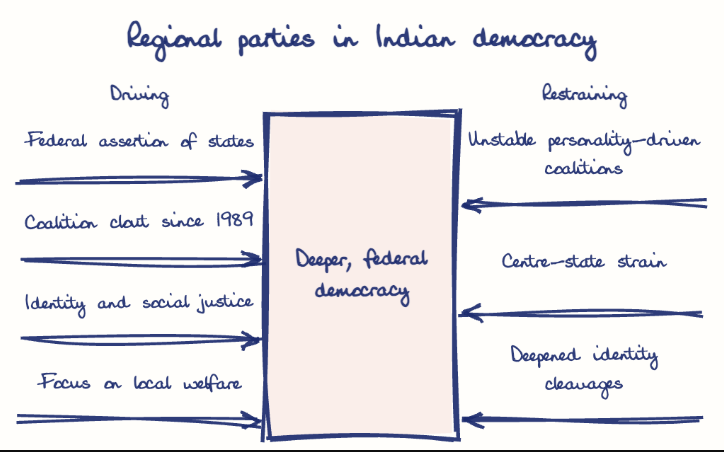
Regional parties have deepened Indian democracy by voicing linguistic, cultural and regional aspirations, ending one-party dominance and making coalition politics and federal bargaining the norm. The DMK's Dravidian politics, Tamil Nadu's 69% reservation and the statehood movement that created Telangana in 2014 show this, though fragmentation remains a risk.
Model answer
Ghissu Editorial · Verified 4 Oct 2026 · 275 words
Federal Structure and Regional Assertion
The Indian federal system enabled regional parties to express state-specific demands, with Telangana’s 2014 formation as a key example demonstrating how regional aspirations can reshape political boundaries and party systems.
Coalition Politics and Power Sharing
Regional parties have ended Congress’s monopoly, institutionalizing coalition governments like the NDA that rely on regional allies. This shift has diversified policy priorities and enhanced states’ political clout at the Centre.
Caste Empowerment and Reservation Expansion1
Tamil Nadu’s DMK and AIADMK governments expanded reservations to 69%, empowering backward classes and caste groups beyond the national limit, thereby promoting social justice and political mobilization.
Economic Disparities and Regional Schemes
Regional parties focus on local welfare, as seen in Telangana’s politically significant schemes like Mission Kakatiya and Rythu Bandhu, which address agrarian distress and water management, strengthening regional political bases.
Coalition Instability and Governance Issues
Personality-driven regional parties sometimes cause unstable coalitions and uneven development, evident in Telangana where governance challenges persist despite political assertion.
Decentralization and Constitutional Backing
Committees like LM Singhvi (1986) support Panchayati Raj empowerment, strengthening grassroots democracy and linking local governance with regional political strength.
This model answer is indicative and the model can make mistakes; please verify key facts independently.
Practise this question
1Get the answer sheet
Sized for this question.
2Write your answer
Timed, by hand.
3Get it marked
Your score and what to fix.
This chapter in the exam
Social issues: poverty, unemployment, communalism, corruption, migration2 questions
Asked in 1 of 2 sittings since 2016
Most tested: Democratic and social cohesion issues at the society–politics interface.
Question from the official TGPSC Group-I Mains 2024 paper. Answer written by Ghissu's engine and checked against our editorial standards. Found an error? Tell us and we correct it within 48 hours.