Critically examine different models of secularism in India.
In short
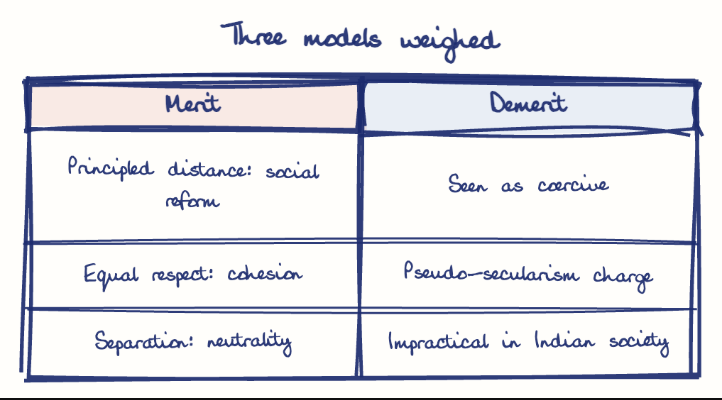
India has three models of secularism: principled distance, where the state may reform religious practice under Article 25; equal respect (sarva dharma sambhava); and a strict Western wall of separation. Principled distance applied consistently with equal respect suits India best, and SR Bommai made secularism part of the basic structure.
Model answer
Ghissu Editorial · Verified 4 Oct 2026 · 256 words
Principled Distance Model
Permits state intervention in religion to reform harmful practices, grounded in Article 25 and exemplified by the Muslim Women (Protection of Rights on Marriage) Act (2019).
Equal Respect Model (Sarva Dharma Sambhava)
Emphasizes equal respect for all religions, with state support for religious events like the Kumbh Mela (the Haj subsidy ended in 2018), reflecting India’s inclusive ethos.
Principled Distance
Balances religious freedom1 and social reform but risks perceptions of bias and communal backlash, as in the Karnataka hijab dispute.
Equal Respect
Encourages social cohesion but criticized for fostering “pseudo-secularism” and vote-bank politics, undermining neutrality.
Religious Diversity and Communalism
Rising majoritarianism and fundamentalism threaten secularism’s core, with communal riots and politicization of religion increasing.
Legal Complexities
Personal laws and the Uniform Civil Code debate complicate secular application; Telangana’s post-statehood communal harmony shows regional sensitivities.
Political Exploitation
Secularism’s accommodation models are vulnerable to vote-bank politics, deepening divides and undermining constitutional morality.
Judicial Role
Courts balance religious freedom and social justice, as in the Shirur Mutt and Sabarimala cases, but face resistance from conservative groups.
Strengthen Constitutional Morality
Promote fraternity and equality through education and discourse.
Enhance Principled Intervention
Develop transparent, consultative state mechanisms sensitive to community sentiments.
This model answer is indicative and the model can make mistakes; please verify key facts independently.
Practise this question
1Get the answer sheet
Sized for this question.
2Write your answer
Timed, by hand.
3Get it marked
Your score and what to fix.
This chapter in the exam
Social issues: poverty, unemployment, communalism, corruption, migration2 questions
Asked in 1 of 2 sittings since 2016
Most tested: Democratic and social cohesion issues at the society–politics interface.
Question from the official TGPSC Group-I Mains 2024 paper. Answer written by Ghissu's engine and checked against our editorial standards. Found an error? Tell us and we correct it within 48 hours.