Analyse the strengths and weaknesses of the Paris Agreement on climate change. How effective is Paris Agreement in addressing global warming?
In short
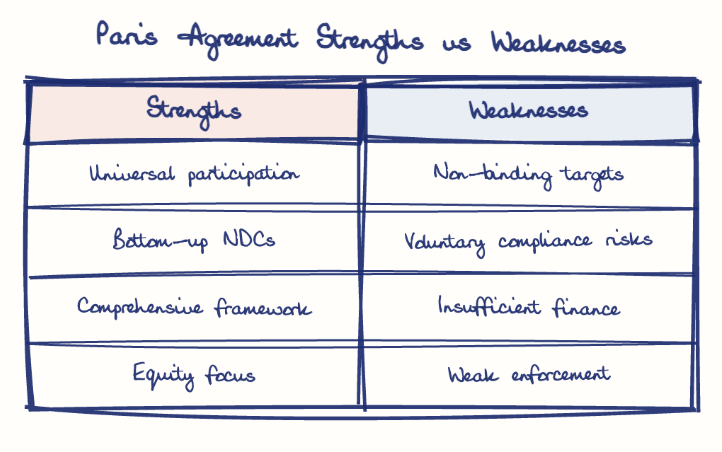
The Paris Agreement (2015) brought all countries into a bottom-up framework of Nationally Determined Contributions, but its targets are non-binding, climate finance is unreliable and enforcement weak, so it is only partly effective. Global emissions keep rising, and 2024 was the hottest year on record at 1.55°C above pre-industrial levels.
Model answer
Ghissu Editorial · Verified 4 Oct 2026 · 320 words
Bottom-Up NDCs and National Ownership
Countries set emission targets every five years; India pledged a 33-35% reduction in emissions intensity from 2005 levels, raised to 45% in 2022, supported by Telangana’s renewable energy projects, enhancing flexibility and ambition. This approach encourages countries to tailor actions to their contexts, increasing engagement and accountability.
Insufficient Climate Finance2 and Delayed Adaptation Funding
Despite pledges of $100 billion annually, funding is inconsistent; COP30 delayed tripling adaptation finance to 2035, weakening support for vulnerable areas like Telangana’s agricultural sectors dependent on Mission Kakatiya. This shortfall hampers developing countries’ capacity to adapt and transition to low-carbon economies.
Global Cooperation and Ambition Platform
The Agreement fosters dialogue and progressive commitments; India’s leadership and the global solar alliance show positive momentum. It also enables technology transfer and capacity building, crucial for sustainable development.
Ambition Gap and Slow Progress
Many NDCs fall short of 1.5°C targets and updated 2035 NDCs came late, limiting effectiveness. The lack of centralized enforcement and transparency mechanisms allows “climate cheating,” slowing global emission reductions.
This model answer is indicative and the model can make mistakes; please verify key facts independently.
Practise this question
1Get the answer sheet
Sized for this question.
2Write your answer
Timed, by hand.
3Get it marked
Your score and what to fix.
This chapter in the exam
Global environmental issues: climate change, sustainable development2 questions
Asked in 1 of 2 sittings since 2016
Most tested: Effectiveness of international climate treaties, especially Kyoto Protocol and Paris Agreement.
Question from the official TGPSC Group-I Mains 2024 paper. Answer written by Ghissu's engine and checked against our editorial standards. Found an error? Tell us and we correct it within 48 hours.