How far have the measures taken by the government succeeded in successful management of solid waste in India? Explain.
In short
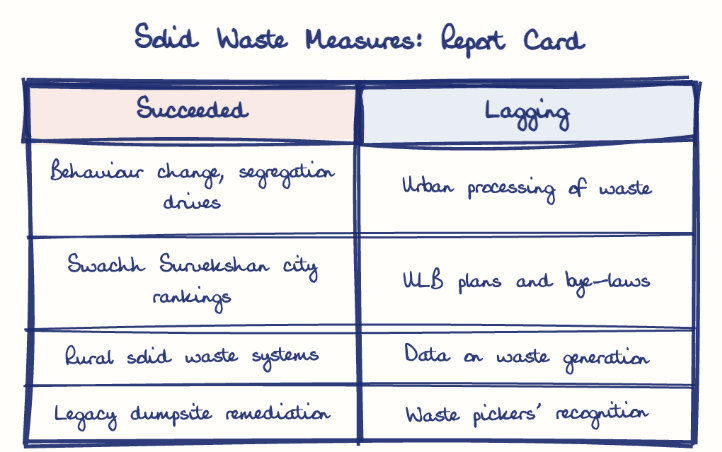
Measures like Swachh Bharat Mission (2014), the Solid Waste Management Rules, 2016 and Swachh Survekshan raised awareness, spurred competition among cities and extended rural coverage to nearly 4 lakh villages. Urban processing and compliance remain weak: in Telangana over 60% of waste in test-checked ULBs was dumped unprocessed in 2021-22.
Model answer
Ghissu Editorial · Verified 4 Oct 2026 · 242 words
Solid Waste Management Rules, 2016
These rules enforce three-stream segregation and assign responsibilities to waste generators, promoting decentralised processing and waste-to-energy solutions.
Swachh Survekshan and Capacity Building
The survey’s expansion to over 4,200 cities by 2020 incentivised improvements; capacity-building by the National Institute of Urban Affairs enhanced governance.
Rural Progress
Nearly 4 lakh villages have adopted solid and liquid waste management systems under SBM (Rural), marking significant rural gains.
Infrastructure and Compliance Deficits
In Telangana, audits reveal 60%+ waste dumped unprocessed in test-checked ULBs, and 37% of SBM funds remain unutilised.
Data and Monitoring Issues
Patchy data and weak monitoring hinder evidence-based policy and effective implementation.
Informal Sector Neglect
Lack of legal recognition and poor coordination among agencies limit integration of informal waste pickers.
Strengthen ULB Capacities
Provide financial, technical, and managerial support for robust SWM plans.
Formalise Informal Sector
Recognise and integrate informal waste workers into formal systems.
This model answer is indicative and the model can make mistakes; please verify key facts independently.
Practise this question
1Get the answer sheet
Sized for this question.
2Write your answer
Timed, by hand.
3Get it marked
Your score and what to fix.
This chapter in the exam
Pollution and solid waste management3 questions
Asked in 2 of 2 sittings since 2016
Most tested: Solid waste management as a governance/implementation issue, especially State or government measures.
Question from the official TGPSC Group-I Mains 2024 paper. Answer written by Ghissu's engine and checked against our editorial standards. Found an error? Tell us and we correct it within 48 hours.