"Solid waste management requires coordinated efforts of State Agencies with community". Comment on the State initiatives towards solid waste management.
In short
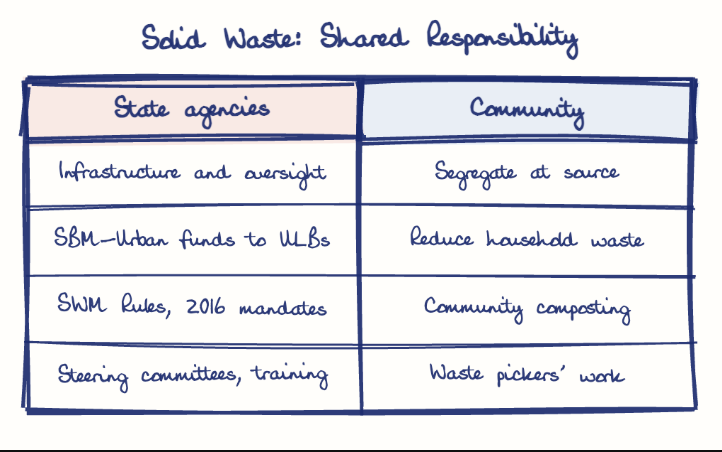
Solid waste management works only when state agencies providing infrastructure and regulation coordinate with communities that segregate waste at source and with informal waste pickers. In Telangana, GHMC processed over 80% of its waste in 2021-22, but other ULBs dumped over 60% unprocessed and left 37% of SBM funds unused.
Model answer
Ghissu Editorial · Verified 4 Oct 2026 · 267 words
Shared Responsibility and Community Role
Waste originates from households and businesses, making community participation in segregation and reduction vital alongside State infrastructure and regulation.
Informal Sector Integration
Formal recognition and support for waste pickers improve system efficiency and inclusivity, a key State-community coordination aspect.
State High Powered Steering Committees
Telangana’s committees oversee SWM policy implementation, ensuring coordination between municipal authorities, State departments, and communities.
Positive Outcomes in Telangana
GHMC processed over 80% of its municipal solid waste3 in 2021-22, reducing landfill dependency through effective State-community coordination.
Persistent Gaps and Fund Utilisation
More than 60% of waste in other Telangana ULBs was dumped unprocessed, and 37% of SBM funds remained unutilised as of March 2022, reflecting challenges in planning and community mobilisation.
Strengthen Awareness and Formalise Informal Workers
Enhance education campaigns and integrate waste pickers with training and social security.
Improve Fund Utilisation and Promote Technology
Better planning and adoption of decentralised, technology-driven solutions can reduce landfill pressure.
This model answer is indicative and the model can make mistakes; please verify key facts independently.
Practise this question
1Get the answer sheet
Sized for this question.
2Write your answer
Timed, by hand.
3Get it marked
Your score and what to fix.
This chapter in the exam
Pollution and solid waste management3 questions
Asked in 2 of 2 sittings since 2016
Most tested: Solid waste management as a governance/implementation issue, especially State or government measures.
Question from the official TGPSC Group-I Mains 2016 paper. Answer written by Ghissu's engine and checked against our editorial standards. Found an error? Tell us and we correct it within 48 hours.