"Industrial policy, in general, determines the pace and pattern of industrialisation of a country/state." Comment on this, keeping in view the Telangana State Industrial Project Approval and Self-Certification System (TS-IPASS).
In short
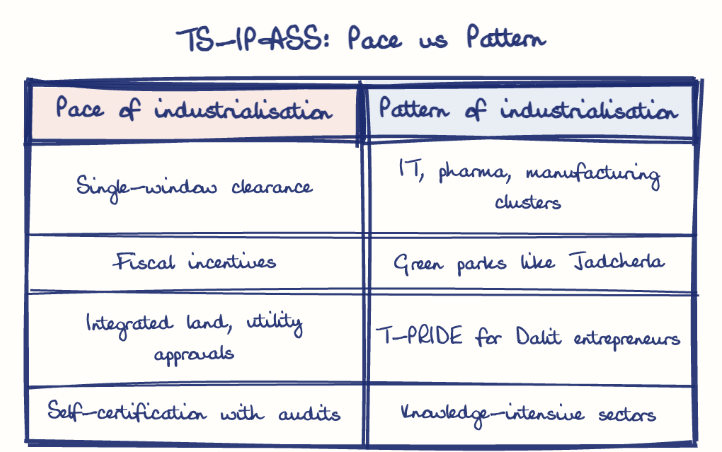
Industrial policy sets both the pace and the pattern of industrialisation, and TS-IPASS proves it: its single-window, self-certification system cut project approvals from months to days. It has steered growth towards IT, pharmaceuticals and clusters like Jadcherla, while schemes like T-PRIDE support Dalit entrepreneurs.
Model answer
Ghissu Editorial · Verified 4 Oct 2026 · 252 words
Incentives Fuel Growth
Telangana’s industrial policy and TS-IPASS have supported a 10.7% GSDP growth in 2025-26, outpacing the national average of 8.0%. Fiscal incentives and infrastructure support under TS-IPASS stimulate private sector participation and capital inflows.
Sectoral Prioritisation and Spatial Planning
Telangana promotes IT, pharmaceuticals, and manufacturing clusters; the tertiary sector contributes 68.6% to GSVA. TS-IPASS supports eco-friendly industrial parks like Jadcherla, which has international green building certifications, guiding sustainable spatial industrial patterns.
Inclusiveness and Innovation
Schemes such as T-PRIDE for SC and ST entrepreneurs and MSME support promote disadvantaged groups, fostering equitable industrial development. Innovation hubs and venture capital funds under the policy encourage high-tech and knowledge-intensive industrialisation.
Ease of Doing Business
TS-IPASS’s self-certification reduces bureaucratic burden while maintaining oversight through random audits, enhancing industrial investment and employment. This has contributed to the secondary sector GSVA growth of 9.4% and an employment share of 22.2% in industry in Telangana.
Challenges and Way Forward
Robust digital infrastructure and capacity building are essential to prevent misuse and ensure environmental and social safeguards. Strengthening real-time monitoring and AI integration can enhance compliance and sustainability.
This model answer is indicative and the model can make mistakes; please verify key facts independently.
Practise this question
1Get the answer sheet
Sized for this question.
2Write your answer
Timed, by hand.
3Get it marked
Your score and what to fix.
This chapter in the exam
Industry, services and ICT policy of Telangana3 questions
Asked in 2 of 2 sittings since 2016
Most tested: Telangana’s policy instruments for industrialisation and service-sector growth.
Question from the official TGPSC Group-I Mains 2024 paper. Answer written by Ghissu's engine and checked against our editorial standards. Found an error? Tell us and we correct it within 48 hours.