"Structural changes are reflected in trends of sectoral shares in gross state value added (GSVA)." Examine this in the context of trends in GSVA of Telangana since 2014.
In short
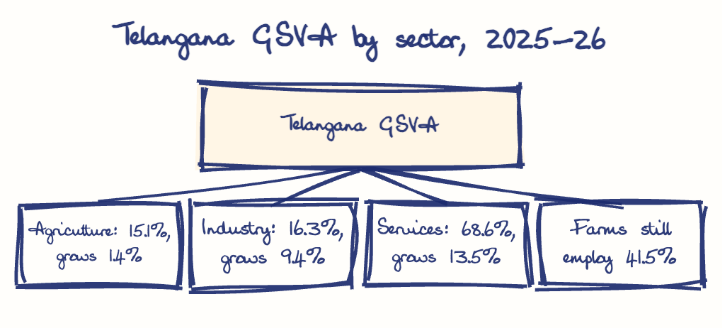
Telangana's GSVA trends since 2014 show a clear services-led structural shift, with agriculture's share shrinking and industry rising only moderately. In 2025-26 services contribute 68.6% of GSVA, industry 16.3% and agriculture 15.1%, though agriculture still employs 41.5% of the workforce.
Model answer
Ghissu Editorial · Verified 4 Oct 2026 · 272 words
Agricultural Modernization and Diversification
Schemes like Rythu Bharosa2 and Mission Kakatiya improved irrigation and farmer support, yet agriculture’s GSVA share declined to 15.1% by 2025-26, despite employing 41.5% of the workforce, indicating underemployment.
Declining Agricultural Share Amid Employment Persistence
Agriculture’s GSVA share fell from over 17% to 15.1%, but it still employs a large workforce, highlighting structural imbalance.
Gradual Industrial Share Increase
Industrial GSVA share rose moderately but remains below national averages5 due to underdeveloped MSMEs and limited value chain deepening.
Agricultural Reforms and GSVA Decline
Direct benefit transfers like Rythu Bharosa and tank restoration under Mission Kakatiya improved farm conditions but did not halt agriculture’s GSVA decline.
Digital and Service Sector Ecosystem
Hyderabad’s IT hubs, including HITEC City, and initiatives like WE Hub have driven the services sector to 68.6% GSVA share with 13.5% growth, reflecting a shift to knowledge-based economy.
Enhance Agricultural Productivity
Strengthen irrigation and diversification under Mission Kakatiya to boost incomes and reduce underemployment.
Revitalize Industrial Governance
Address SPSE inefficiencies to unlock industrial sector growth.
This model answer is indicative and the model can make mistakes; please verify key facts independently.
Sources
Practise this question
1Get the answer sheet
Sized for this question.
2Write your answer
Timed, by hand.
3Get it marked
Your score and what to fix.
This chapter in the exam
Telangana economy: Hyderabad State, united AP, GSDP, poverty3 questions
Asked in 2 of 2 sittings since 2016
Most tested: Fiscal and structural analysis of Telangana’s economy in relation to united Andhra Pradesh and post-2014 state performance.
Question from the official TGPSC Group-I Mains 2024 paper. Answer written by Ghissu's engine and checked against our editorial standards. Found an error? Tell us and we correct it within 48 hours.