2013 · GS Paper 1 · Q23(a) · 5 marks
Do you agree that there is a growing trend of opening new sugar mills in southern States of India? Discuss with justification.
In short
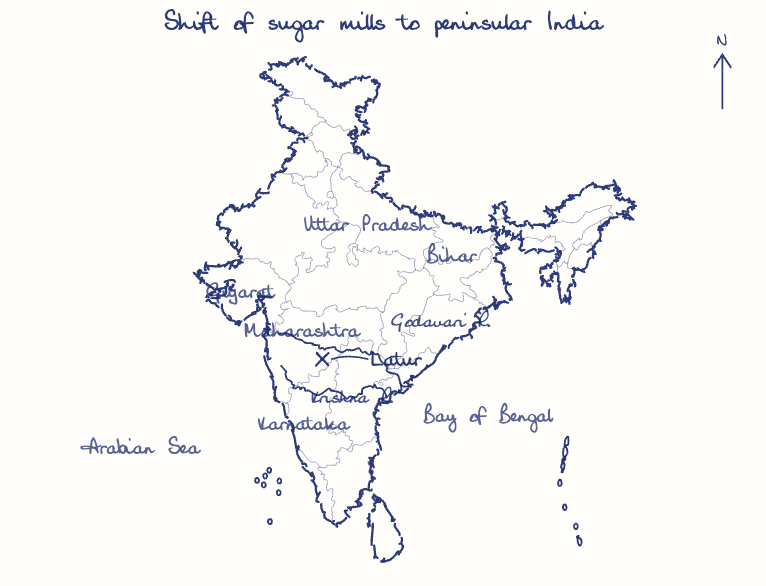
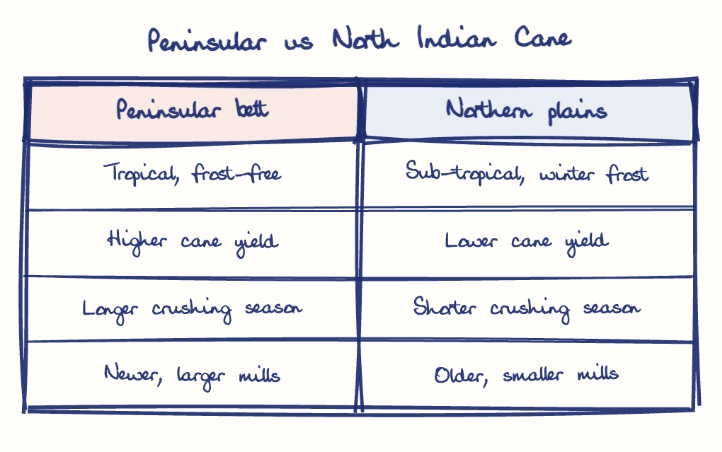
New sugar mills have largely come up in peninsular India, especially Maharashtra and Karnataka, because of a frost-free climate, higher-sucrose cane, cooperatives and irrigation. The trend is uneven, as water stress halted new Marathwada licences after 2016 and Uttar Pradesh revived through the Co-0238 variety.
Model answer
Ghissu Editorial · Verified 4 Oct 2026 · 290 words
Agro-climatic edge
The frost-free climate and Deccan soils give thicker cane with higher sucrose, so each tonne yields more sugar.
Cooperative model
Since the Pravara cooperative at Loni (1950), farmer-owned mills have spread across Maharashtra, Karnataka and Gujarat.
Assured irrigation
Krishna, Godavari and Kaveri irrigation supports a 12 to 18 month cane crop.
Scale and by-products
Large new mills with co-generation and distilleries made Maharashtra the top producer in the early 2010s.
Water stress
Cane uses most of Maharashtra's irrigation water, and after the 2016 Latur water trains the state stopped licensing new mills in Marathwada.
Uneven south
Tamil Nadu and Andhra Pradesh saw closures and sick mills in drought years, so growth is concentrated in two states.
Northern revival
The Co-0238 variety lifted recovery in Uttar Pradesh, which regained the top spot in the late 2010s.
Regulatory brake
The 15 km distance norm under the Sugarcane (Control) Order, 1966 limits clustering of mills.
This model answer is indicative and the model can make mistakes; please verify key facts independently.
Practise this question
1Get the answer sheet
Sized for this question.
2Write your answer
Timed, by hand.
3Get it marked
Your score and what to fix.
This chapter in the exam
International Trade / Transport and Activities12 questions
Asked in 9 of 14 sittings since 2013
- 2026"The centre of global trade is gradually shifting from the Atlantic region to the Indo-Pacific region." Examine this statement.
- 2022Mention the significance of straits and isthmus in international trade.
All 12 questions, sorted by sub-topic, with model answers and practice.
Question from the official UPSC Civil Services (Main) Examination 2013 paper. Answer written by Ghissu's engine and checked against our editorial standards. Found an error? Tell us and we correct it within 48 hours.