2013 · GS Paper 2 · Q6 · 10 marks
Constitutional mechanisms to resolve the inter-state water disputes have failed to address and solve the problems. Is the failure due to structural or process inadequacy or both? Discuss.
In short
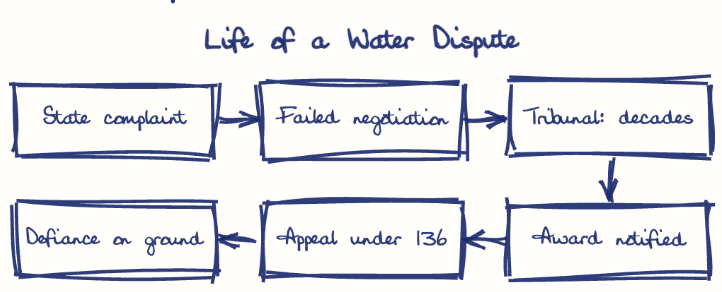
The failure of India's water-dispute machinery is due to both structural and process inadequacy: ad hoc tribunals and weak enforcement invite delay and political defiance. The Cauvery tribunal took 17 years to give its 2007 award, which the Supreme Court still recast in 2018.
Model answer
Ghissu Editorial · Verified 4 Oct 2026 · 287 words
Ad hoc tribunals
Each dispute gets a new tribunal with no permanent memory or neutral data arm, and the Sarkaria Commission (1988) urged time limits.
Unused Union power
Parliament's Entry 56 power lies idle, since no board was ever formed under the River Boards Act, 1956.
Incomplete finality
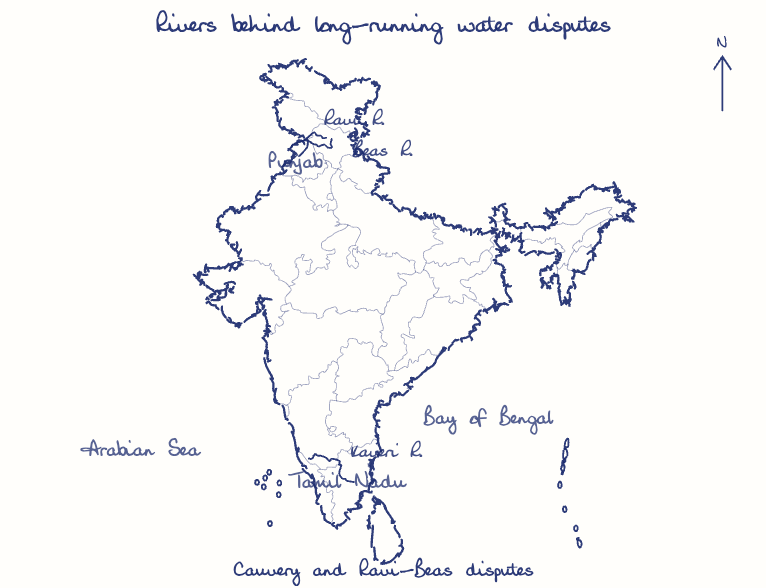
The Supreme Court hears appeals under Article 136, as when its 2018 Cauvery verdict cut Tamil Nadu's share to 404.25 tmcft.
Weak enforcement
Awards gained decree force only in 2002, and the Cauvery Water Management Authority came only in 2018.
Chronic delay
The Ravi-Beas tribunal of 1986 has still not given a final report.
Political defiance
Punjab's 2004 law annulling its water accords was struck down only in the 2016 Presidential Reference.
Contested data
Each state brings its own hydrological figures, and tribunals spend years reconciling them without a neutral basin database.
Negotiation bypassed
The Inter-State Council under Article 263 is rarely used, and no distress-sharing formula exists for deficit years.
This model answer is indicative and the model can make mistakes; please verify key facts independently.
Practise this question
1Get the answer sheet
Sized for this question.
2Write your answer
Timed, by hand.
3Get it marked
Your score and what to fix.
This chapter in the exam
Functions and Responsibilities of the Union and the States7 questions
Asked in 7 of 14 sittings since 2013
- 2026How far has the Indian federal framework been successful in accommodating regional and cultural diversities ? Highlight the role of asymmetric federalism and suggest measures to make dispute resolution mechanisms more effective.
- 2025Examine the evolving pattern of Centre-State financial relations in the context of planned development in India. How far have the recent reforms impacted the fiscal federalism in India?
All 7 questions, sorted by sub-topic, with model answers and practice.
Question from the official UPSC Civil Services (Main) Examination 2013 paper. Answer written by Ghissu's engine and checked against our editorial standards. Found an error? Tell us and we correct it within 48 hours.