2013 · GS Paper 2 · Q4 · 10 marks
The Supreme Court of India keeps a check on arbitrary power of the Parliament in amending the Constitution. Discuss critically.
In short
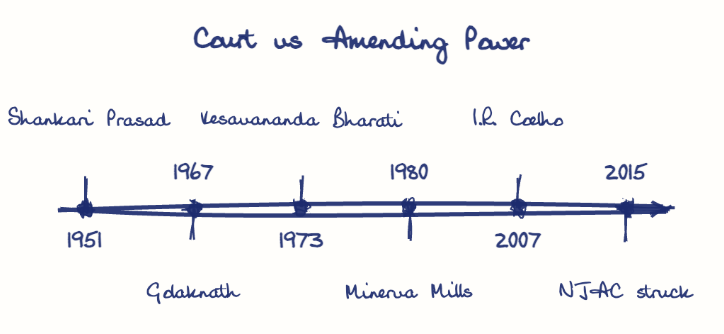
The Supreme Court checks Parliament's amending power through the basic structure doctrine, striking down only amendments that attack the Constitution's core, while critics fault the doctrine's vagueness. Kesavananda Bharati (1973) set the test, later applied in Minerva Mills (1980) and the NJAC case (2015).
Model answer
Ghissu Editorial · Verified 4 Oct 2026 · 289 words
Shifting positions
Shankari Prasad (1951) gave Parliament full power, Golaknath (1967) barred amending Fundamental Rights, and Kesavananda settled on the basic structure test, under which every Article may be amended but the Constitution's core identity may not.
Striking excesses
Indira Gandhi v. Raj Narain (1975) struck the 39th Amendment's shield for the Prime Minister's election, and Minerva Mills (1980) voided the 42nd Amendment's bar on judicial review.
Extending the shield
I.R. Coelho (2007) opened post-1973 Ninth Schedule laws to review, and the NJAC case (2015) struck the 99th Amendment to protect judicial independence.
Restraint shown
The Court upheld the 103rd Amendment on EWS quotas in Janhit Abhiyan (2022), so the check is not a blanket veto.
Vague content
The basic structure has no exhaustive list, which lets unelected judges decide what elected representatives may change, a concern the Vice-President raised publicly in 2023.
Self-interest charge
In the NJAC verdict judges preserved their own role in appointments, which critics see as overreach.
This model answer is indicative and the model can make mistakes; please verify key facts independently.
Practise this question
1Get the answer sheet
Sized for this question.
2Write your answer
Timed, by hand.
3Get it marked
Your score and what to fix.
This chapter in the exam
Separation of Powers between Various Organs4 questions
Asked in 4 of 14 sittings since 2013
- 2020Judicial Legislation is antithetical to the doctrine of separation of powers as envisaged in the Indian Constitution. In this context justify the filing of large number of public interest petitions praying for issuing guidelines to executive authorities.
- 2019Do you think that constitution of India does not accept principle of strict separation of powers rather it is based on the principle of checks and balance? Explain.
All 4 questions, sorted by sub-topic, with model answers and practice.
Question from the official UPSC Civil Services (Main) Examination 2013 paper. Answer written by Ghissu's engine and checked against our editorial standards. Found an error? Tell us and we correct it within 48 hours.