2020 · GS Paper 2 · Q12 · 15 marks
Judicial Legislation is antithetical to the doctrine of separation of powers as envisaged in the Indian Constitution. In this context justify the filing of large number of public interest petitions praying for issuing guidelines to executive authorities.
In short
Judicial legislation strains the separation of powers, but public interest petitions seeking guidelines are justified where executive and legislative silence leaves fundamental rights unprotected. The Vishaka guidelines of 1997 held the field until Parliament enacted the POSH Act 2013.
Model answer
Ghissu Editorial · Verified 4 Oct 2026 · 266 words
Legislative vacuum
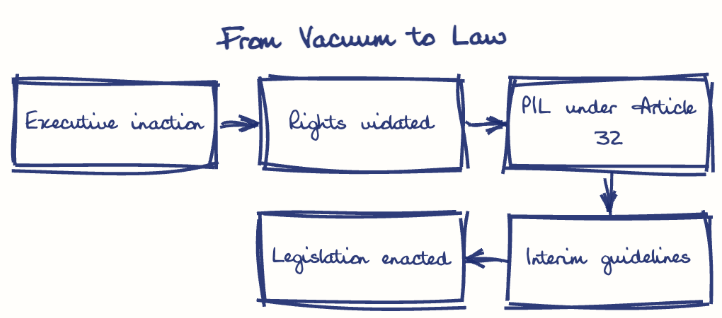
Vishaka (1997) framed workplace harassment guidelines under Articles 32 and 141 that held the field until the POSH Act 2013.
Executive inaction
D.K. Basu (1997) set arrest safeguards, Lalita Kumari (2014) made FIRs mandatory, and Prakash Singh (2006) ordered long-ignored police reforms.
Access and new threats
S.P. Gupta (1981) relaxed locus standi, and Tehseen Poonawalla (2018) issued anti-lynching guidelines while urging Parliament to legislate.
Constitutional basis
Article 142 permits complete justice, Ram Jawaya Kapur (1955) held that India has no strict separation, and guidelines lapse once Parliament legislates.
Risk of overreach
K. Balu (2016) banned liquor within 500 metres of highways and later diluted the order after States cited lost jobs and revenue, while Balwant Singh Chaufal (2010) set filters against frivolous PILs.
Dialogic, time-bound remedies
Courts should first set deadlines for governments to frame policy, issue guidelines only on default, and give them a review date that prompts legislation.
This model answer is indicative and the model can make mistakes; please verify key facts independently.
Practise this question
1Get the answer sheet
Sized for this question.
2Write your answer
Timed, by hand.
3Get it marked
Your score and what to fix.
This chapter in the exam
Separation of Powers between Various Organs4 questions
Asked in 4 of 14 sittings since 2013
- 2019Do you think that constitution of India does not accept principle of strict separation of powers rather it is based on the principle of checks and balance? Explain.
- 2015Resorting to ordinances has always raised concern on violation of the spirit of separation of powers doctrine. While noting the rationales justifying the power to promulgate ordinances, analyze whether the decisions of the Supreme Court on the issue have further facilitated resorting to this power. Should the power to promulgate ordinances be repealed?
All 4 questions, sorted by sub-topic, with model answers and practice.
Question from the official UPSC Civil Services (Main) Examination 2020 paper. Answer written by Ghissu's engine and checked against our editorial standards. Found an error? Tell us and we correct it within 48 hours.