2019 · GS Paper 2 · Q1 · 10 marks
Do you think that constitution of India does not accept principle of strict separation of powers rather it is based on the principle of checks and balance? Explain.
In short
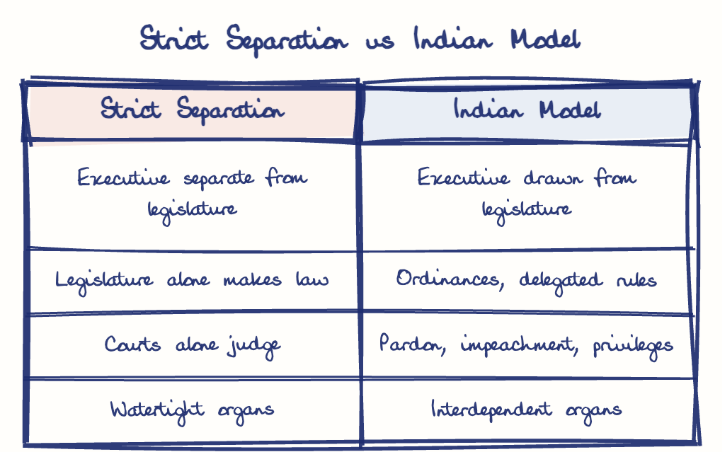
The Indian Constitution rejects strict separation of powers and relies on checks and balances, with overlapping functions but protected cores for each organ. Ram Jawaya Kapur (1955) held that India recognises only a differentiation of functions.
Model answer
Ghissu Editorial · Verified 4 Oct 2026 · 292 words
Parliamentary fusion
Ministers sit in Parliament and are collectively responsible to the Lok Sabha under Article 75(3).
Overlapping functions
Ordinances under Articles 123 and 213 let the executive legislate, the President pardons under Article 72, and Parliament removes judges under Article 124(4).
Judicial rule-making
The Supreme Court frames its own rules under Article 145 and issues binding directions for complete justice under Article 142, entering terrain that is otherwise legislative.
Legislature over executive
No-confidence motions, Question Hour and the Public Accounts Committee's scrutiny of CAG reports keep the government answerable.
Executive over judiciary
The President appoints judges, though the collegium restored by the NJAC case (2015) tempers this check.
Judiciary over both
Judicial review under Articles 13, 32 and 226, and the basic structure from Kesavananda Bharati (1973), limit laws and amendments.
Insulated cores
Articles 121 and 122 shield judges' conduct and legislative procedure from each other, and Indira Gandhi v Raj Narain (1975) made separation of powers part of the basic structure.
This model answer is indicative and the model can make mistakes; please verify key facts independently.
Practise this question
1Get the answer sheet
Sized for this question.
2Write your answer
Timed, by hand.
3Get it marked
Your score and what to fix.
This chapter in the exam
Separation of Powers between Various Organs4 questions
Asked in 4 of 14 sittings since 2013
- 2020Judicial Legislation is antithetical to the doctrine of separation of powers as envisaged in the Indian Constitution. In this context justify the filing of large number of public interest petitions praying for issuing guidelines to executive authorities.
- 2015Resorting to ordinances has always raised concern on violation of the spirit of separation of powers doctrine. While noting the rationales justifying the power to promulgate ordinances, analyze whether the decisions of the Supreme Court on the issue have further facilitated resorting to this power. Should the power to promulgate ordinances be repealed?
All 4 questions, sorted by sub-topic, with model answers and practice.
Question from the official UPSC Civil Services (Main) Examination 2019 paper. Answer written by Ghissu's engine and checked against our editorial standards. Found an error? Tell us and we correct it within 48 hours.