2013 · GS Paper 2 · Q16 · 10 marks
Though Citizens' charters have been formulated by many public service delivery organizations, there is no corresponding improvement in the level of citizens' satisfaction and quality of services being provided? Analyze.
In short
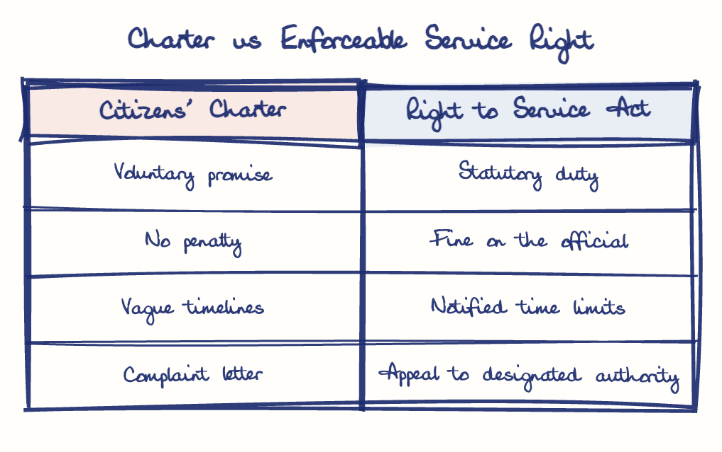
Citizens' Charters have not raised satisfaction because they are drafted top-down, poorly publicised, rarely revised and carry no penalty for breach. The Citizens' Charter and Grievance Redressal Bill, 2011 lapsed, and state Right to Services laws show that enforceability is what makes service promises bite.
Model answer
Ghissu Editorial · Verified 4 Oct 2026 · 295 words
Top-down drafting
Departments wrote charters without consulting users or frontline staff, so the promised standards rarely match citizens' real needs.
No legal teeth
A charter is voluntary and carries no penalty for breach; the Citizens' Charter and Grievance Redressal Bill, 2011, which would have made it enforceable, lapsed in 2014.
Low awareness
Charters are seldom publicised, often appear only in English or jargon, and ignore the special needs of the elderly, disabled and rural poor.
Static and unowned
Few are ever revised, staff are neither trained in them nor rewarded for meeting them, and the mindset still treats citizens as passive beneficiaries.
Sevottam discipline
The DARPG's Sevottam model links the charter to grievance redressal and delivery capability, making standards measurable.
Statutory guarantee
Madhya Pradesh's Public Services Guarantee Act, 2010, and other Right to Services laws fine officials for delay, which has made time limits bite.
Digital feedback
CPGRAMS lets citizens track grievances and give feedback, turning the charter into a live performance contract.
This model answer is indicative and the model can make mistakes; please verify key facts independently.
Practise this question
1Get the answer sheet
Sized for this question.
2Write your answer
Timed, by hand.
3Get it marked
Your score and what to fix.
This chapter in the exam
Citizens Charters3 questions
Asked in 3 of 14 sittings since 2013
- 2024The Citizens' charter has been a landmark initiative in ensuring citizen-centric administration. But it is yet to reach its full potential. Identify the factors hindering the realisation of its promise and suggest measures to overcome them.
- 2018The Citizens' Charter is an ideal instrument of organizational transparency and accountability, but it has its own limitations. Identify the limitations and suggest measures for greater effectiveness of the Citizens' Charter.
Question from the official UPSC Civil Services (Main) Examination 2013 paper. Answer written by Ghissu's engine and checked against our editorial standards. Found an error? Tell us and we correct it within 48 hours.