2024 · GS Paper 2 · Q16 · 15 marks
The Citizens' charter has been a landmark initiative in ensuring citizen-centric administration. But it is yet to reach its full potential. Identify the factors hindering the realisation of its promise and suggest measures to overcome them.
In short
Citizens' Charters fall short because they are drafted without citizens, lack measurable standards and legal force, and meet unaware users, untrained staff and weak redress. The 2011 Citizens' Charter Bill lapsed in 2014, so statutory service guarantees remain the key missing measure.
Model answer
Ghissu Editorial · Verified 4 Oct 2026 · 279 words
Top-down drafting
Departments write charters for citizens, not with them, missing the needs of the elderly, disabled and rural users.
Vague, uniform standards
Copied templates promise "prompt service" instead of measurable timelines.
No legal teeth
Charters are unenforceable, and the 2011 Citizens' Charter Bill lapsed in 2014.
Unaware citizens
Charters are rarely publicised in local languages or accessible formats.
Untrained staff
Frontline employees are seldom trained, and frequent transfers of nodal officers break continuity.
Weak redress and audit
Breaches bring no compensation or penalty, and no outside agency audits compliance.
Statutory backing
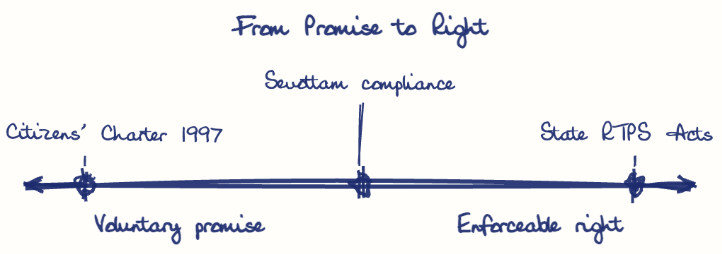
Enact a central service-guarantee law on the lines of Madhya Pradesh's Lok Sewa Guarantee Act, 2010, with compensation for delay.
Co-designed standards
Draft charters with users and civil society, and revise them yearly, as the 2nd ARC advised.
Capacity and attitude
Train staff through Mission Karmayogi and link charter performance to staff appraisals, with offices assessed against Sevottam.
Digital feedback
Integrate charters with CPGRAMS and real-time feedback, like Kadapa's QR codes (2026) and Chhattisgarh's single platform for 441 services.
This model answer is indicative and the model can make mistakes; please verify key facts independently.
Practise this question
1Get the answer sheet
Sized for this question.
2Write your answer
Timed, by hand.
3Get it marked
Your score and what to fix.
This chapter in the exam
Citizens Charters3 questions
Asked in 3 of 14 sittings since 2013
- 2018The Citizens' Charter is an ideal instrument of organizational transparency and accountability, but it has its own limitations. Identify the limitations and suggest measures for greater effectiveness of the Citizens' Charter.
- 2013Though Citizens' charters have been formulated by many public service delivery organizations, there is no corresponding improvement in the level of citizens' satisfaction and quality of services being provided? Analyze.
Question from the official UPSC Civil Services (Main) Examination 2024 paper. Answer written by Ghissu's engine and checked against our editorial standards. Found an error? Tell us and we correct it within 48 hours.