2013 · GS Paper 3 · Q10 · 10 marks
Discuss the rationale for introducing Goods and Services Tax (GST) in India. Bring out critically the reasons for the delay in roll out for its regime.
In short
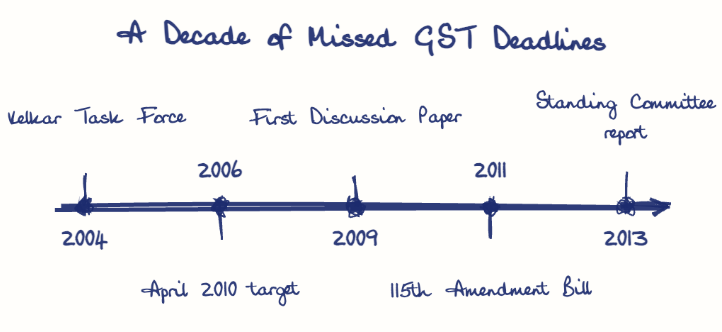
GST was introduced to end tax cascading, unify a fragmented national market and widen the tax base, but its roll-out was delayed by states' fears of revenue loss and lost fiscal autonomy. The 115th Amendment Bill of 2011 stalled over petroleum, alcohol, compensation and a proposed Dispute Settlement Authority.
Model answer
Ghissu Editorial · Verified 4 Oct 2026 · 293 words
Ending cascading
Excise could not be set off against state VAT, and CST could not be set off at all; GST gives input tax credit across the chain.
One national market
Entry tax, octroi and check posts fragmented trade, which a uniform levy would remove.
Wider base and growth
A dual GST lets both governments tax goods and services, and the NCAER study for the Thirteenth Finance Commission (2009) estimated a GDP gain of 0.9 to 1.7%.
Revenue fears
Producing states like Gujarat and Tamil Nadu feared losses under a destination tax, and unpaid CST compensation deepened distrust.
Fiscal autonomy
States opposed the proposed Dispute Settlement Authority as an intrusion on their power to tax.
Contested coverage
Petroleum, alcohol and entry tax remained sticking points while the Standing Committee examined the 2011 Bill.
Political and technical hurdles
The amendment needed a special majority and ratification by half the states, and the GST Network was set up only in 2013.
This model answer is indicative and the model can make mistakes; please verify key facts independently.
Practise this question
1Get the answer sheet
Sized for this question.
2Write your answer
Timed, by hand.
3Get it marked
Your score and what to fix.
This chapter in the exam
Fiscal Federalism4 questions
Asked in 4 of 14 sittings since 2013
- 2025Explain how the Fiscal Health Index (FHI) can be used as a tool for assessing the fiscal performance of states in India. In what way would it encourage the states to adopt prudent and sustainable fiscal policies ?
- 2020Explain the rationale behind the Goods and Services Tax (Compensation to States) Act of 2017. How has COVID-19 impacted the GST compensation fund and created new federal tensions?
All 4 questions, sorted by sub-topic, with model answers and practice.
Question from the official UPSC Civil Services (Main) Examination 2013 paper. Answer written by Ghissu's engine and checked against our editorial standards. Found an error? Tell us and we correct it within 48 hours.