2020 · GS Paper 3 · Q12 · 15 marks
Explain the rationale behind the Goods and Services Tax (Compensation to States) Act of 2017. How has COVID-19 impacted the GST compensation fund and created new federal tensions?
In short
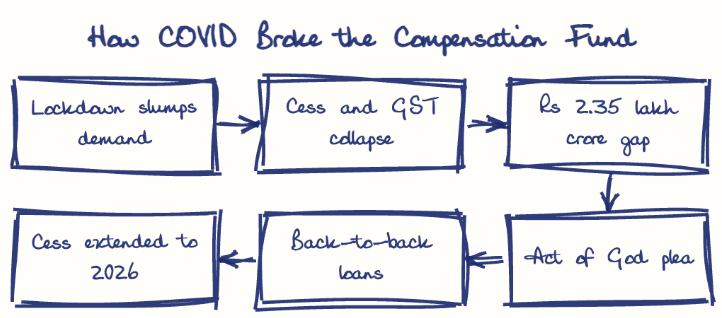
The 2017 Act guaranteed states 14% annual revenue growth for five years, funded by a cess, to win their consent to surrender taxing powers under GST. COVID-19 collapsed the cess pool, leaving a Rs 2.35 lakh crore gap that the Centre met through back-to-back loans, fuelling federal distrust.
Model answer
Ghissu Editorial · Verified 4 Oct 2026 · 285 words
Constitutional commitment
Section 18 of the 101st Amendment required five years of compensation, and the Act guaranteed 14% annual growth over 2015-16 revenue until June 2022.
Insurance for producing states
Destination-based GST threatened manufacturing states such as Tamil Nadu and Gujarat, so a guarantee won their consent.
Ring-fenced funding
A cess on pan masala, tobacco, aerated drinks, cars and coal fed a GST Compensation Fund.
Borrowing instead of payment
The Centre borrowed Rs 1.1 lakh crore in 2020-21 and Rs 1.59 lakh crore in 2021-22 as back-to-back loans, repaid by extending the cess to March 2026.
Trust deficit
A CAG report (2020) found Rs 47,272 crore of cess retained in the Consolidated Fund, and Kerala, Punjab and West Bengal saw the guarantee as diluted.
Council imbalance
The Centre's one-third vote gives it a veto, and Mohit Minerals (2022) held Council recommendations non-binding.
Rule-based resolution
Activate the dispute mechanism under Article 279A(11) and build states' own revenue now that the cess has ended.
This model answer is indicative and the model can make mistakes; please verify key facts independently.
Practise this question
1Get the answer sheet
Sized for this question.
2Write your answer
Timed, by hand.
3Get it marked
Your score and what to fix.
This chapter in the exam
Fiscal Federalism4 questions
Asked in 4 of 14 sittings since 2013
- 2025Explain how the Fiscal Health Index (FHI) can be used as a tool for assessing the fiscal performance of states in India. In what way would it encourage the states to adopt prudent and sustainable fiscal policies ?
- 2019Enumerate the indirect taxes which have been subsumed in the Goods and Services Tax (GST) in India. Also, comment on the revenue implications of the GST introduced in India since July 2017.
All 4 questions, sorted by sub-topic, with model answers and practice.
Question from the official UPSC Civil Services (Main) Examination 2020 paper. Answer written by Ghissu's engine and checked against our editorial standards. Found an error? Tell us and we correct it within 48 hours.