2025 · GS Paper 3 · Q11 · 15 marks
Explain how the Fiscal Health Index (FHI) can be used as a tool for assessing the fiscal performance of states in India. In what way would it encourage the states to adopt prudent and sustainable fiscal policies ?
In short
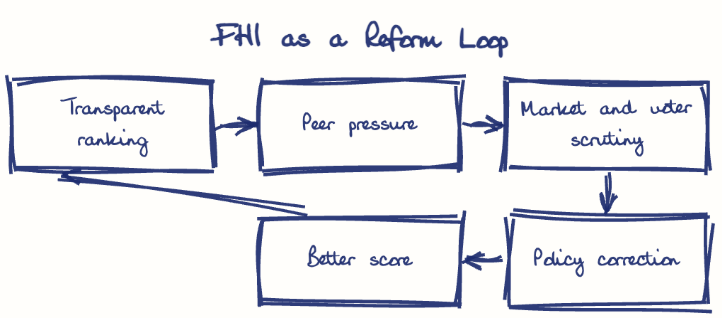
NITI Aayog's Fiscal Health Index assesses 18 major states on expenditure quality, revenue mobilisation, fiscal prudence, debt and debt sustainability, and its public ranking spurs prudence through peer pressure and market scrutiny. In the 2025 edition Odisha led with a score of 67.8 while Punjab ranked last.
Model answer
Ghissu Editorial · Verified 4 Oct 2026 · 279 words
Five sub-indices
Quality of Expenditure, Revenue Mobilisation, Fiscal Prudence, Debt Index and Debt Sustainability together prevent a state from hiding weak capital spending behind a low deficit.
Benchmarking
Odisha led with 67.8 while Punjab ranked last, and capital outlay ranged from about 27% of development spending in Madhya Pradesh to about 10% in West Bengal.
Early warning
Tracking debt and interest burdens against GSDP and revenue flags states drifting towards unsustainable borrowing.
Competitive federalism
Public ranking creates the peer pressure that the Ease of Doing Business rankings created, nudging laggards to copy leaders.
Cheaper borrowing
With market loans above half of state liabilities by 2019, a better profile can lower borrowing costs.
Revenue effort
Odisha and Jharkhand raising about 21% of revenue from non-tax sources shows others what is possible.
Discipline on freebies
A visible fall in prudence scores raises the political cost of untargeted subsidies.
Incentives and coverage
Link scores to Finance Commission performance grants and include off-budget borrowings and guarantees so scores reflect true debt.
This model answer is indicative and the model can make mistakes; please verify key facts independently.
Practise this question
1Get the answer sheet
Sized for this question.
2Write your answer
Timed, by hand.
3Get it marked
Your score and what to fix.
This chapter in the exam
Fiscal Federalism4 questions
Asked in 4 of 14 sittings since 2013
- 2020Explain the rationale behind the Goods and Services Tax (Compensation to States) Act of 2017. How has COVID-19 impacted the GST compensation fund and created new federal tensions?
- 2019Enumerate the indirect taxes which have been subsumed in the Goods and Services Tax (GST) in India. Also, comment on the revenue implications of the GST introduced in India since July 2017.
All 4 questions, sorted by sub-topic, with model answers and practice.
Question from the official UPSC Civil Services (Main) Examination 2025 paper. Answer written by Ghissu's engine and checked against our editorial standards. Found an error? Tell us and we correct it within 48 hours.