2013 · GS Paper 3 · Q17(b) · 5 marks
What do you understand by Run-of-river hydroelectricity project? How is it different from any other hydroelectricity project?
In short
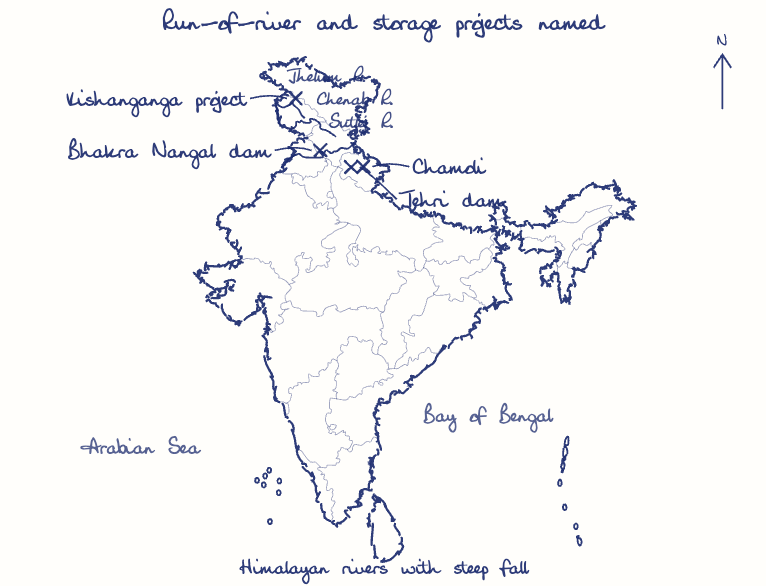
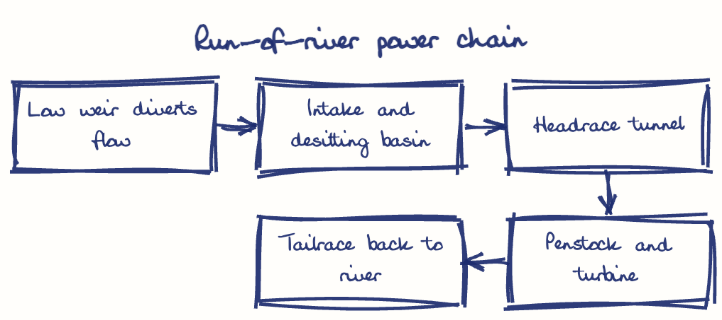
A run-of-river project generates electricity from a river's natural flow and fall with little or no storage, unlike storage projects that impound large reservoirs. Nathpa Jhakri on the Satluj runs on flow with small pondage, while Tehri regulates water through a large lake.
Model answer
Ghissu Editorial · Verified 4 Oct 2026 · 275 words
Head over storage
Output depends on the drop between intake and turbine, so steep Himalayan rivers suit it, as at Nathpa Jhakri (1,500 MW) on the Satluj.
Flow-dependent output
Generation peaks with snowmelt and monsoon and falls in lean winter months, since there is no large reservoir to store water.
Pondage variant
Some keep a small pond to shift a few hours of flow into peak demand, the limited storage allowed on the Jhelum and Chenab.
Reservoir size
Tehri on the Bhagirathi impounds a large lake that regulates flow across the year, while a run-of-river plant passes water through almost at once.
Submergence and displacement
Tehri submerged old Tehri town, whereas run-of-river projects submerge far less land and displace fewer people.
Multipurpose role
Storage dams like Bhakra also give irrigation and flood control, while run-of-river plants mainly make electricity.
Distinct ecological risk
Tunnels can leave river stretches nearly dry, and the 2021 Chamoli flood destroyed the Rishiganga project.
This model answer is indicative and the model can make mistakes; please verify key facts independently.
Practise this question
1Get the answer sheet
Sized for this question.
2Write your answer
Timed, by hand.
3Get it marked
Your score and what to fix.
This chapter in the exam
Conservation19 questions
Asked in 11 of 14 sittings since 2013
- 2026Discuss the aim and goals of Kunming-Montreal global biodiversity framework. Mention India's commitments and initiatives to achieve the goals and targets of this framework giving suitable examples. (Answer in 150 words)
- 2025What is Carbon Capture, Utilization and Storage (CCUS) ? What is the potential role of CCUS in tackling climate change ?
All 19 questions, sorted by sub-topic, with model answers and practice.
Question from the official UPSC Civil Services (Main) Examination 2013 paper. Answer written by Ghissu's engine and checked against our editorial standards. Found an error? Tell us and we correct it within 48 hours.