2013 · GS Paper 4 · Q9 · 20 marks
A Public Information Officer has received an application under RTI Act. Having gathered the information, the PIO discovers that the information pertains to some of the decisions taken by him, which were found to be not altogether right. There were other employees also who were party to these decisions. Disclosure of the information is likely to lead to disciplinary action with possibility of punishment against him as well as some of his colleagues. Non-disclosure or part disclosure or camouflaged disclosure of information will result into lesser punishment or no punishment. The PIO is otherwise an honest and conscientious person but this particular decision, on which the RTI application has been filed, turned out to be wrong. He comes to you for advice. The following are some suggested options. Please evaluate the merits and demerits of each of the options: (i) The PIO could refer the matter to his superior officer and seek his advice and act strictly in accordance with the advice, even though he is not completely in agreement with the advice of the superior. (ii) The PIO could proceed on leave and leave the matter to be dealt by his successor in office or request for transfer of the application to another PIO. (iii) The PIO could weigh the consequences of disclosing the information truthfully, including the effect on his career, and reply in a manner that would not place him or his career in jeopardy, but at the same time a little compromise can be made on the contents of the information. (iv) The PIO could consult his other colleagues who are party to the decision and take action as per their advice. Also please indicate (without necessarily restricting to the above options) what you would like to advise, giving proper reasons.
In short
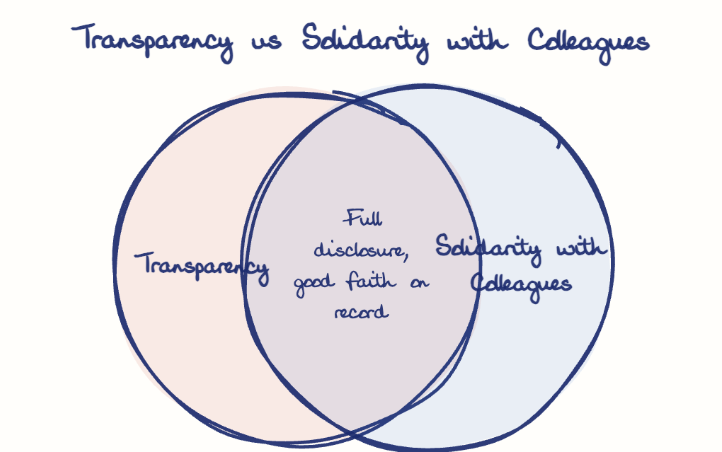
The PIO should reject all four suggested options and disclose the information fully and on time, owning the error while recording that the decision was taken in good faith. The Supreme Court held in Union of India v J. Ahmed (1979) that an error of judgment is not, by itself, misconduct.
Model answer
Ghissu Editorial · Verified 4 Oct 2026 · 273 words
(i) CAPITULATE [Compromised-Hybrid]
Obeying the superior shares responsibility but is Conscience Laundering through Hierarchy; the duty is the PIO's own.
(ii) EVADE [Procedural-Evasive]
Leave or transfer removes the conflict but is Moral Escapism, and Section 6(3) provides only for transfer to another public authority.
(iii) COMPROMISE [Compromised-Hybrid]
Diluted content saves his career but is Yudhishthira's Half-Truth, penalised under Section 20.
(iv) CAPITULATE [Empathetic-Humanitarian]
Following colleagues shows loyalty but is In-Group Bias and a collective cover-up.
(v) RECONCILE ✓ [Balanced]
Disclose fully, own the error and defend good faith (recommended).
Disclose on time
Give complete information within 30 days, as no Section 8 exemption covers embarrassment; the 2nd ARC (2006) [committee/report] called openness the master key to good governance.
Own the error
Record the good-faith context, since J. Ahmed (1979) [case] held an error of judgment is not misconduct by itself.
Support colleagues fairly
Inform them in advance and help them prepare their explanations, so loyalty means a fair defence, not concealment.
This model answer is indicative and the model can make mistakes; please verify key facts independently.
Practise this question
1Get the answer sheet
Sized for this question.
2Write your answer
Timed, by hand.
3Get it marked
Your score and what to fix.
This chapter in the exam
Integrity Under Pressure7 questions
Asked in 6 of 14 sittings since 2013
- 2025Subash is Secretary, PWD in the State Government. He is a senior officer, known for his competence, integrity and dedication to work. He enjoys the trust and confidence of Minister Incharge of PWD and Programme Implementation. As a part of his job profile, he is responsible for policy formulation, execution of projects relating to infrastructure initiatives in the State. Besides, he oversees the technical and administrative aspects relating to planning, designing and construction etc. Subash's Minister is an important Minister in the state and significant growth in urban infrastructure development and road network has been registered during his tenure. He is very keen for launching of ambitious road construction project in the near future. Subash is in regular touch with the Minister and is working various modalities of road construction project. Regular meetings, interactions and presentations are made by him to the Minister before a formal public announcement of the project is made by the Minister. Subash's only son Vikas is in real estate business. His son from his own sources is aware that a mega road project is on the anvil and announcement in this regard is expected anytime. He is very keen to know from his father the exact location of the upcoming project. He knows that there would be quantum jump in the prices of land in the vicinity. Buying land at this stage at cheaper prices would pay him rich dividends. He is pleading with him (his father) day in and day out to share him location of the proposed project. He assured him that he would handle the matter discretely as it would not attract any adverse notice as he in the normal course, keeps on buying land as a part of his business. He feels pressurised because of constant pleadings by his son. Another significant aspect of the matter pertained to the extra/undue interest in the above project by the Minister PWD. His nephew was also having big infrastructure project company. In fact, the Minister has also introduced his nephew to him and indicated to him to take care of his nephew's business interest in the forthcoming project. The Minister encouraged him to act fast in the matter as early announcement and execution of mega road project would enhance his status in the party and public life. (a) Discuss the ethical issues involved in the case. (b) Critically examine the options available to Subash in the above situation. (c) Which of the above would be most appropriate and why?
- 2022Ramesh is a State Civil Services Officer who got the opportunity of getting posted to the capital of a border State after rendering 20 years of service. Ramesh's mother has recently been detected cancer and has been admitted in the leading cancer hospital of the city. His two adolescent children have also got admission in one of the best public schools of the town. After settling down in his appointment as Director in the Home Department of the State, Ramesh got confidential report through intelligence sources that illegal migrants are infiltrating in the State from the neighbouring country. He decided to personally carry out surprise check of the border posts along with his Home Department team. To his surprise, he caught red-handed two families of 12 members infiltrated with the connivance of the security personnel at the border posts. On further inquiry and investigation, it was found that after the migrants from neighbouring country infiltrate, their documentation like Aadhaar Card, Ration Card and Voter Card are also forged and they are made to settle down in a particular area of the State. Ramesh prepared the detailed and comprehensive report and submitted to the Additional Secretary of the State. However, he has summoned by the Additional Home Secretary after a week and was instructed to withdraw the report. The Additional Home Secretary informed Ramesh that the report submitted by him has not been appreciated by the higher authorities. He further cautioned him that if he fails to withdraw the confidential report, he will not only be posted out from the prestigious appointment from the State capital but his further promotion which is due in near future will also get in jeopardy. (a) What are the options available to Ramesh as the Director of the Home Department of the bordering State? (b) What option should Ramesh adopt and why? (c) Critically evaluate each of the options. (d) What are the ethical dilemmas being faced by Ramesh? (e) What policy measures would you suggest to combat the menace of infiltration of illegal migrants from the neighbouring country?
All 7 questions, sorted by sub-topic, with model answers and practice.
Question from the official UPSC Civil Services (Main) Examination 2013 paper. Answer written by Ghissu's engine and checked against our editorial standards. Found an error? Tell us and we correct it within 48 hours.