2014 · GS Paper 1 · Q6 · 10 marks
Examine critically the various facets of economic policies of the British in India from mid-eighteenth century till independence.
In short
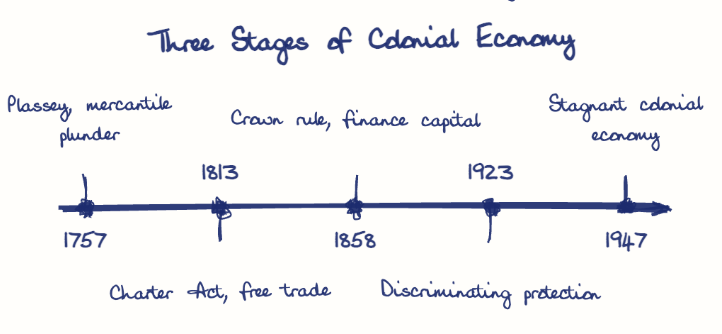
British economic policy moved from mercantile plunder after Plassey to free-trade capitalism after 1813 and finance imperialism after 1858, modernising the economy's shell while deindustrialising and draining it. India's share of world output fell from about a quarter in 1700 to barely 4% by 1950.
Model answer
Ghissu Editorial · Verified 4 Oct 2026 · 283 words
Mercantilist plunder
After Plassey and the Diwani of 1765, Bengal's revenue financed the Company's purchases, and weavers were bound to monopoly contracts.
Free-trade capitalism
The Charter Act of 1813 opened India to Manchester cloth while Indian textiles faced high British tariffs, and the 1793 Permanent Settlement, Ryotwari and Mahalwari maximised revenue.
Finance imperialism
After 1858 British capital took a 5% guaranteed return on railways and moved into plantations and banking, while Home Charges and remittances formed the drain Naoroji exposed.
Deindustrialisation
Ruined crafts drove artisans onto land, and dependence on agriculture rose from 63.7% in 1901 to 70% in 1941, as Bipan Chandra notes.
Famines and stagnation
Famines from Bengal 1770 to Bengal 1943 exposed negligible growth in per capita income.
Ambivalent modernisation
Railways, Punjab canal colonies and a unified market served exports and control more than development, though discriminating protection after 1923 helped steel and sugar.
This model answer is indicative and the model can make mistakes; please verify key facts independently.
Practise this question
1Get the answer sheet
Sized for this question.
2Write your answer
Timed, by hand.
3Get it marked
Your score and what to fix.
This chapter in the exam
Colonialism4 questions
Asked in 4 of 14 sittings since 2013
- 2022Why was there a sudden spurt in famines in colonial India since the mid-eighteenth century? Give reasons.
- 2018Why indentured labour was taken by the British from India to other colonies? Have they been able to preserve their cultural identity over there?
All 4 questions, sorted by sub-topic, with model answers and practice.
Question from the official UPSC Civil Services (Main) Examination 2014 paper. Answer written by Ghissu's engine and checked against our editorial standards. Found an error? Tell us and we correct it within 48 hours.