2022 · GS Paper 1 · Q3 · 10 marks
Why was there a sudden spurt in famines in colonial India since the mid-eighteenth century? Give reasons.
In short
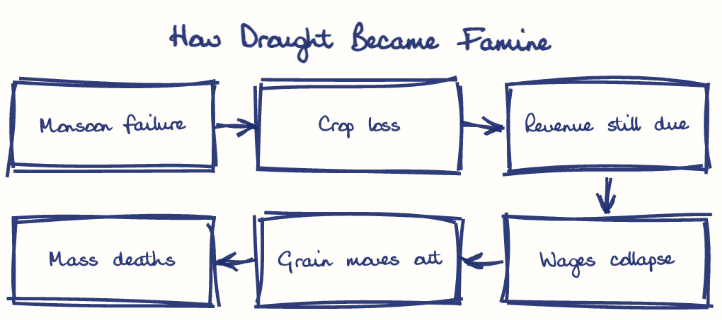
Famines multiplied in colonial India because high cash land revenue, cash crops, ruined crafts, grain exports, the drain and laissez-faire relief stripped peasants of any buffer, so droughts became mass death. In 1770 the Company kept collecting revenue while a third of Bengal's people perished.
Model answer
Ghissu Editorial · Verified 4 Oct 2026 · 283 words
Rigid land revenue
The Permanent Settlement, Ryotwari and Mahalwari collected high cash demands even in drought, and in 1770 collections continued while, by Warren Hastings' estimate, a third of Bengal perished.
Cash crops
Indigo, cotton, jute and opium displaced foodgrains and household grain stocks.
Ruined crafts and debt
The loss of craft income removed the cushion against bad harvests, and court-backed moneylenders seized land and grain.
Drain of wealth
Naoroji and R.C. Dutt showed that Home Charges carried away the surplus needed for storage and relief.
Exports during scarcity
Railways moved grain out of famine districts, and Lytton refused to halt exports in 1876-78.
Laissez-faire relief
Richard Temple's 1877 ration of one pound of grain a day for heavy labour left relief workers starving.
Neglected irrigation
Railways got the funds while tanks decayed, until the Famine Commission of 1880 urged protective works.
Climatic triggers
El Nino droughts in 1876-78 and 1896-1900 hit this weakened system, Mike Davis's "late Victorian holocausts".
This model answer is indicative and the model can make mistakes; please verify key facts independently.
Practise this question
1Get the answer sheet
Sized for this question.
2Write your answer
Timed, by hand.
3Get it marked
Your score and what to fix.
This chapter in the exam
Colonialism4 questions
Asked in 4 of 14 sittings since 2013
- 2018Why indentured labour was taken by the British from India to other colonies? Have they been able to preserve their cultural identity over there?
- 2017Examine how the decline of traditional artisanal industry in colonial India crippled the rural economy.
All 4 questions, sorted by sub-topic, with model answers and practice.
Question from the official UPSC Civil Services (Main) Examination 2022 paper. Answer written by Ghissu's engine and checked against our editorial standards. Found an error? Tell us and we correct it within 48 hours.