2014 · GS Paper 1 · Q2 · 10 marks
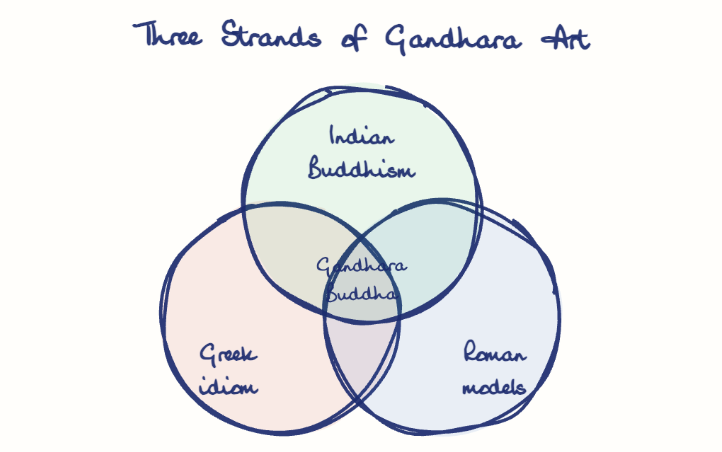
Gandhara sculpture owed as much to the Romans as to the Greeks. Explain.
In short
Gandhara sculpture took its classical grammar, the Apollo-like face and contrapposto, from the Greek legacy of Bactria, but its toga-like drapery, continuous friezes and garland-bearing cupids from Roman models. Mortimer Wheeler's Roman thesis rests on Kushana-era dating, Pliny's 50-million-sesterce drain and the Begram hoard.
Model answer
Ghissu Editorial · Verified 4 Oct 2026 · 269 words
Apollonian Buddha
The oval face, straight nose and wavy hair over the ushnisha recall Apollo, a type the Indo-Greek kings of Bactria brought to the Indus region.
Realism and motifs
Contrapposto posture, anatomical modelling, Indo-Corinthian capitals at Jamalgarhi and Herakles reworked as Vajrapani show Hellenistic roots going back to Alexander (326 BCE).
Toga-like drapery
The heavy sanghati in thick folds over both shoulders follows the toga of Roman imperial statues rather than the clinging Greek chiton.
Narrative friezes
Continuous life-of-the-Buddha panels and garland-bearing cupids copy the format of Roman sarcophagi.
Trade and objects
Pliny complained that India drained 50 million sesterces a year from Rome, and the Begram hoard near Kabul held Roman bronzes and Alexandrian glass beside Indian ivories.
Portraits and stucco
Kushana donor portraits and the stucco heads of Taxila and Hadda follow Roman provincial workshop practice.
This model answer is indicative and the model can make mistakes; please verify key facts independently.
Practise this question
1Get the answer sheet
Sized for this question.
2Write your answer
Timed, by hand.
3Get it marked
Your score and what to fix.
This chapter in the exam
Art Forms10 questions
Asked in 8 of 14 sittings since 2013
- 2025The sculptors filled the Chandella artform with resilient vigor and breadth of life.' Elucidate.
- 2022Discuss the significance of the lion and bull figures in Indian mythology, art and architecture.
All 10 questions, sorted by sub-topic, with model answers and practice.
Question from the official UPSC Civil Services (Main) Examination 2014 paper. Answer written by Ghissu's engine and checked against our editorial standards. Found an error? Tell us and we correct it within 48 hours.