2014 · GS Paper 1 · Q10 · 10 marks
The New Economic Policy-1921 of Lenin had influenced the policies adopted by India soon after independence. Evaluate.
In short
Lenin's NEP influenced post-independence India only partly, mainly through the idea of a mixed economy with the state holding the commanding heights. The Industrial Policy Resolution of 1956 reserved 17 industries for the state, but Mahalanobis planning followed Stalin's Five Year Plans and democratic consent.
Model answer
Ghissu Editorial · Verified 4 Oct 2026 · 307 words
Commanding heights with the state
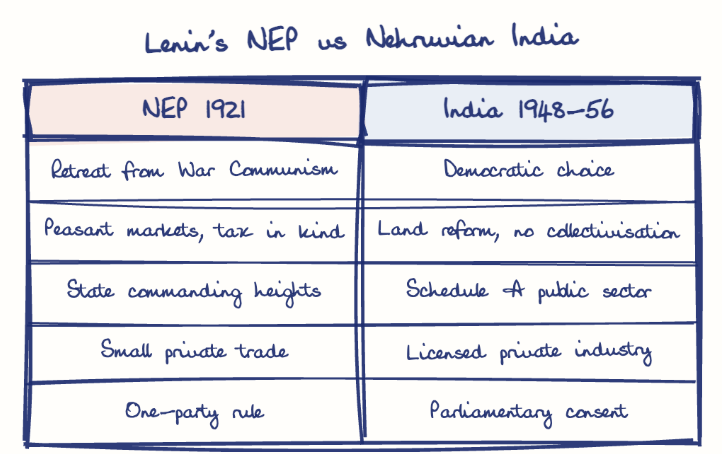
The Industrial Policy Resolution of 1956 reserved 17 Schedule A industries, including iron and steel and railways, for the state, close to the NEP's control of large industry.
Space for private enterprise
The 1948 and 1956 Resolutions kept a role for private industry, and the Karve Committee (1955) backed village industries.
Peasant farming and planning
Like Lenin, India left farming to peasants, choosing zamindari abolition and tenancy reform over collective farms, and Gosplan (1921) prefigured India's Planning Commission (1950).
Stalin's plans, not Lenin's NEP
The Mahalanobis model of the Second Plan (1956) owed more to Soviet Five Year Plans begun in 1928.
Other sources
The National Planning Committee (1938), the Bombay Plan (1944), Fabian socialism and Keynes shaped the mixed economy as much as Moscow.
Democratic choice
The NEP was a tactical retreat under one-party rule; India's mixed economy was a lasting choice under a Constitution with rights and Article 39's Directive Principles.
This model answer is indicative and the model can make mistakes; please verify key facts independently.
Practise this question
1Get the answer sheet
Sized for this question.
2Write your answer
Timed, by hand.
3Get it marked
Your score and what to fix.
This chapter in the exam
Events from the 18th Century: Revolutions4 questions
Asked in 4 of 14 sittings since 2013
- 2025The French Revolution has enduring relevance to the contemporary world. Explain.
- 2019Explain how the foundations of the modern world were, laid by the American and French Revolutions.
All 4 questions, sorted by sub-topic, with model answers and practice.
Question from the official UPSC Civil Services (Main) Examination 2014 paper. Answer written by Ghissu's engine and checked against our editorial standards. Found an error? Tell us and we correct it within 48 hours.