2014 · GS Paper 1 · Q1 · 10 marks
To what extent has the urban planning and culture of the Indus Valley Civilization provided inputs to the present day urbanization? Discuss.
In short
The Indus Valley Civilisation has shaped present-day urbanisation only partially as a direct inheritance, but largely as a benchmark of grid planning, sanitation and water management. Dholavira's reservoirs and Mohenjo-daro's covered drains linking almost every house remain models that flood-prone modern Indian cities still struggle to match.
Model answer
Ghissu Editorial · Verified 4 Oct 2026 · 268 words
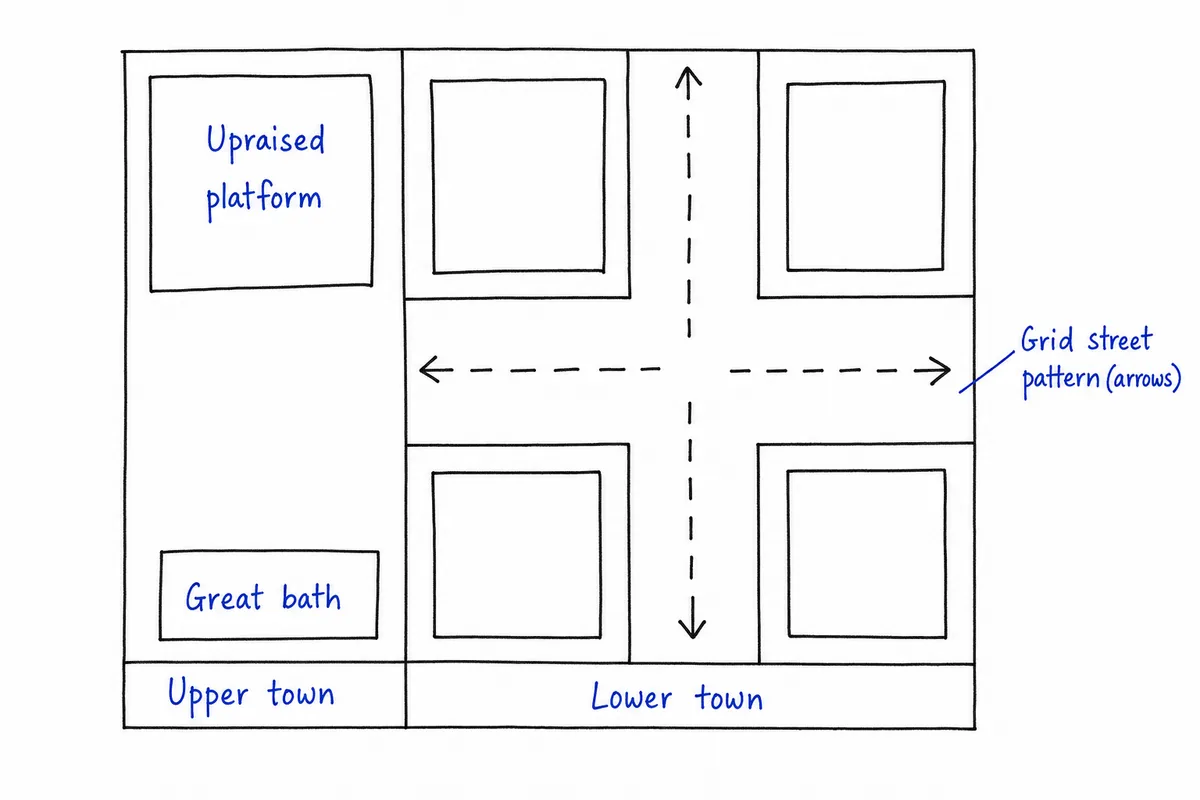
Planned grid layout
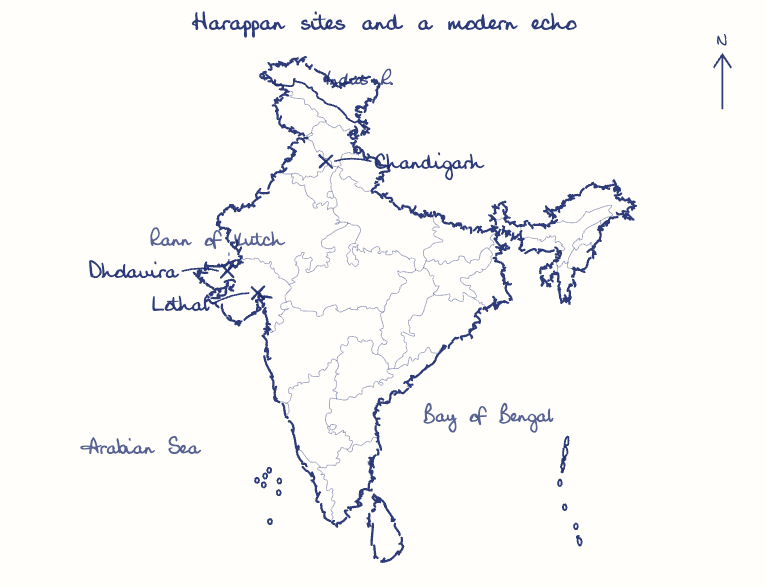
Streets at right angles and a raised citadel apart from the lower town anticipate the zoning of planned cities such as Chandigarh.
Sanitation as public duty
Covered drains with inspection holes linked almost every house, the principle behind modern underground sewerage.
Water management
Dholavira's reservoirs harvested scarce rain in the Rann of Kutch, a model for urban rainwater harvesting today.
Standards and trade
Bricks in a fixed 1:2:4 ratio, uniform weights and Lothal's dockyard reflect the standardisation and port-led commerce modern cities depend on.
Broken continuity
Harappan urbanism declined around 1900 BCE, and the Gangetic second urbanisation grew independently.
Modern templates elsewhere
Present cities follow colonial cantonments, Le Corbusier's Chandigarh and statutory master plans; the Harappan cities were identified as a civilisation only in the 1920s.
Cultural, not urban, continuity
The bullock cart, ritual bathing in temple tanks and Khambhat's bead-making persist in culture more than in planning.
Lessons ignored
Recurrent urban floods and open drains show India has often failed to match Harappan civic discipline.
This model answer is indicative and the model can make mistakes; please verify key facts independently.
Practise this question
1Get the answer sheet
Sized for this question.
2Write your answer
Timed, by hand.
3Get it marked
Your score and what to fix.
This chapter in the exam
Architecture8 questions
Asked in 8 of 14 sittings since 2013
- 2026Vijayanagara architecture exemplifies the amalgamation of past traditions with contemporary practices. Elucidate with examples.
- 2025Discuss the salient features of the Harappan architecture.
All 8 questions, sorted by sub-topic, with model answers and practice.
Question from the official UPSC Civil Services (Main) Examination 2014 paper. Answer written by Ghissu's engine and checked against our editorial standards. Found an error? Tell us and we correct it within 48 hours.