2014 · GS Paper 1 · Q22 · 10 marks
Why did the Green Revolution in India virtually by-pass the eastern region despite fertile soil and good availability of water?
In short
The Green Revolution bypassed eastern India because zamindari-era tenancy, tiny holdings, floods instead of controlled irrigation and wheat-first HYV technology blocked adoption despite fertile soil and water. Banerjee and Iyer (2005) found former landlord districts adopted high-yielding varieties and irrigation more slowly.
Model answer
Ghissu Editorial · Verified 4 Oct 2026 · 293 words
Zamindari legacy
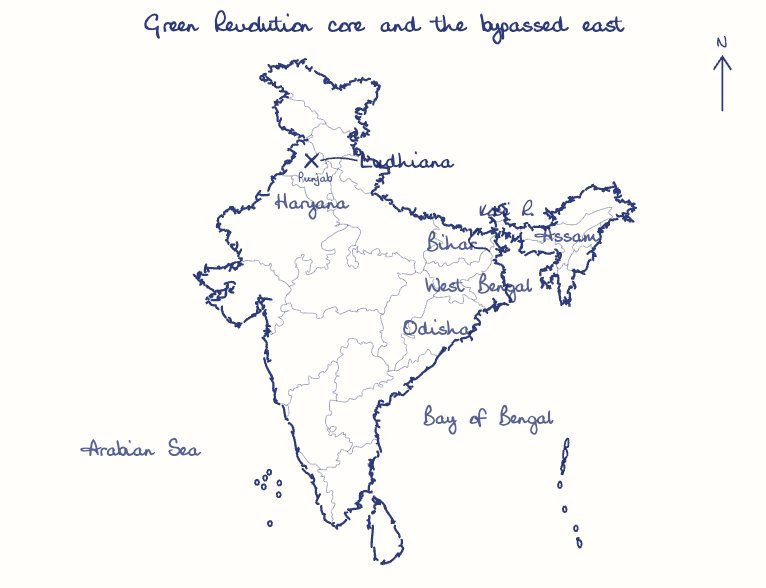
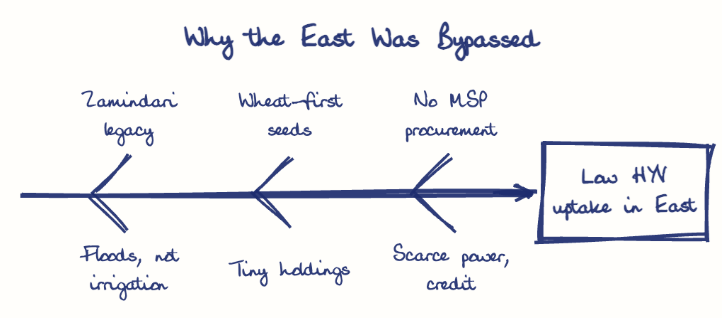
The Permanent Settlement (1793) left absentee landlords and insecure sharecroppers in Bihar, Bengal and Odisha, and Banerjee and Iyer (2005) found such districts adopted HYVs and irrigation more slowly.
Tiny holdings, no credit
Tenants without land records could not borrow for seed, fertiliser and pumps, and land reform stayed on paper except West Bengal's Operation Barga (1978).
Skewed targeting
The Intensive Agricultural District Programme (1960-61) chose assured-irrigation districts such as Ludhiana, and FCI procurement at MSP concentrated in Punjab and Haryana.
Floods, not irrigation
HYVs need controlled water, but the Kosi, Brahmaputra and Mahanadi brought floods and waterlogging that ruined fertiliser-intensive crops.
Wheat-first seeds
Borlaug's dwarf wheats suited Punjab's irrigated rabi, while IR-8 rice did not suit the east's flood-prone paddy.
Power deficit
Weak rural electrification and costly diesel kept tubewells scarce over the east's rich aquifers, while Punjab energised pumps early.
Thin support network
Mandis, link roads and cooperative banks were sparse, so inputs arrived late and surpluses sold cheap.
This model answer is indicative and the model can make mistakes; please verify key facts independently.
Practise this question
1Get the answer sheet
Sized for this question.
2Write your answer
Timed, by hand.
3Get it marked
Your score and what to fix.
This chapter in the exam
Resources and planning38 questions
Asked in 14 of 14 sittings since 2013
- 2026"Water resources are both an asset and a source of conflict in South Asia." Examine this statement giving examples.
- 2026Analyze the role of satellite-based technologies in achieving climate-smart agriculture and food security in India.
All 38 questions, sorted by sub-topic, with model answers and practice.
Question from the official UPSC Civil Services (Main) Examination 2014 paper. Answer written by Ghissu's engine and checked against our editorial standards. Found an error? Tell us and we correct it within 48 hours.