2026 · GS Paper 1 · Q7 · 10 marks
"Water resources are both an asset and a source of conflict in South Asia." Examine this statement giving examples.
In short
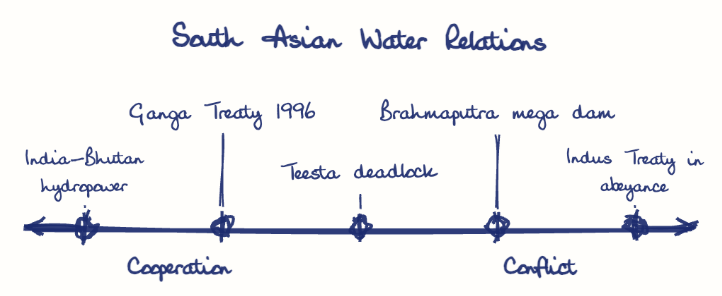
South Asian rivers are an asset where treaties and benefit-sharing work, as with Bhutan's hydropower and the Ganga Waters Treaty, and a conflict source where trust fails. India placed the Indus Waters Treaty (1960) in abeyance after the Pahalgam attack in April 2025.
Model answer
Ghissu Editorial · Verified 4 Oct 2026 · 274 words
Treaty resilience
The World Bank-brokered Indus Waters Treaty (1960) divided the eastern and western rivers and survived three wars.
Hydropower bond
Bhutan's Chukha, Tala and Mangdechhu (720 MW, 2019) sell power to India, making hydropower Bhutan's biggest export.
Flow-sharing compacts
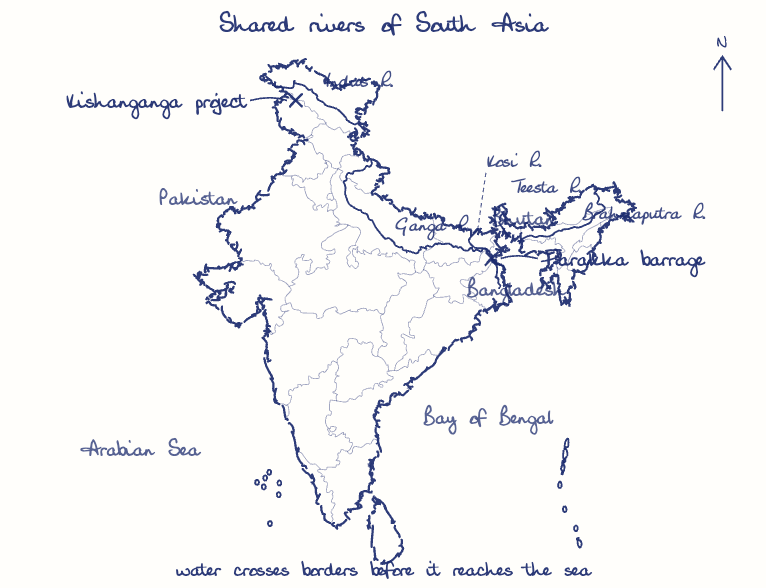
The Ganga Waters Treaty (1996) at Farakka and the Kosi (1954) and Gandak (1959) agreements with Nepal show cooperative sharing.
Development diplomacy
India built Afghanistan's Salma Dam, the Afghan-India Friendship Dam inaugurated in 2016, to irrigate Herat province.
Indus under strain
After disputes over Kishenganga and Ratle, India placed the treaty in abeyance following the Pahalgam attack of April 2025.
Upstream China
China's mega dam at Medog on the Yarlung Tsangpo, begun in July 2025, alarms India and Bangladesh about flows and seismic risk.
Teesta and Cauvery
The 2011 Teesta deal stalled over West Bengal's objections, and the Cauvery dispute flares in distress years despite the 2018 Supreme Court verdict.
This model answer is indicative and the model can make mistakes; please verify key facts independently.
Practise this question
1Get the answer sheet
Sized for this question.
2Write your answer
Timed, by hand.
3Get it marked
Your score and what to fix.
This chapter in the exam
Resources and planning38 questions
Asked in 14 of 14 sittings since 2013
- 2026Analyze the role of satellite-based technologies in achieving climate-smart agriculture and food security in India.
- 2026Analyze the major drivers of human-induced land-use changes in India and their geographical consequences.
All 38 questions, sorted by sub-topic, with model answers and practice.
Question from the official UPSC Civil Services (Main) Examination 2026 paper. Answer written by Ghissu's engine and checked against our editorial standards. Found an error? Tell us and we correct it within 48 hours.