2014 · GS Paper 2 · Q14 · 12 marks
Has the Cadre based Civil Services Organization been the cause of slow change in India? Critically examine.
In short
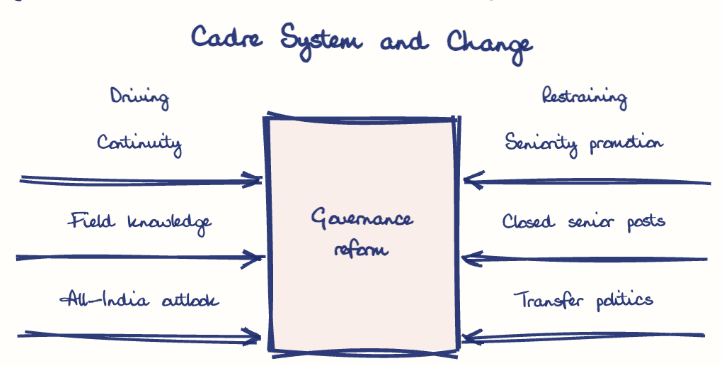
The cadre-based civil service is a partial but not the principal cause of slow change: seniority promotion, closed senior posts and generalist rotation blunt innovation. Political transfers and procedural drag weigh as heavily, so mid-career domain tagging, lateral entry and Civil Services Boards should reform rather than replace it.
Model answer
Ghissu Editorial · Verified 4 Oct 2026 · 288 words
Seniority over merit
Batch-wise promotion lets capable and indifferent officers rise together, blunting incentives to innovate.
Closed shop at the top
Senior posts stay largely with cadre officers; Aadhaar needed an outsider, Nandan Nilekani, at UIDAI from 2009.
Generalist rotation
Frequent moves prevent mastery of sectors such as telecom regulation or climate finance.
Steel frame of unity
Sardar Patel defended the All India Services in 1949, and cadre continuity has delivered elections and disaster responses such as Odisha's Cyclone Fani evacuation (2019).
Political interference
Ashok Khemka's dozens of transfers show punitive postings, not the cadre, deter bold officers.
Procedural drag
Fear of investigation slows decisions, which is why Section 17A was added to the Prevention of Corruption Act in 2018.
Domain tagging
Assigning officers to sectors at mid-career, as the Second ARC advised, would add depth.
Open senior posts
A share of senior posts should go through UPSC-run lateral selection that respects reservation.
Insulated tenure
Functional Civil Services Boards, as T.S.R. Subramanian (2013) directed, would tie postings to merit.
This model answer is indicative and the model can make mistakes; please verify key facts independently.
Practise this question
1Get the answer sheet
Sized for this question.
2Write your answer
Timed, by hand.
3Get it marked
Your score and what to fix.
This chapter in the exam
Role of Civil Services in a Democracy6 questions
Asked in 6 of 14 sittings since 2013
- 2026Analyse the advantages and limitations of the generalist structure of the Indian Civil Services in contemporary governance.
- 2024The Doctrine of Democratic Governance makes it necessary that the public perception of the integrity and commitment of civil servants becomes absolutely positive. Discuss.
All 6 questions, sorted by sub-topic, with model answers and practice.
Question from the official UPSC Civil Services (Main) Examination 2014 paper. Answer written by Ghissu's engine and checked against our editorial standards. Found an error? Tell us and we correct it within 48 hours.