2014 · GS Paper 2 · Q13 · 12 marks
Should the premier institutes like IITs/IIMs be allowed to retain premier status, allowed more academic independence in designing courses and also decide mode/criteria of selection of students. Discuss in light of the growing challenges.
In short
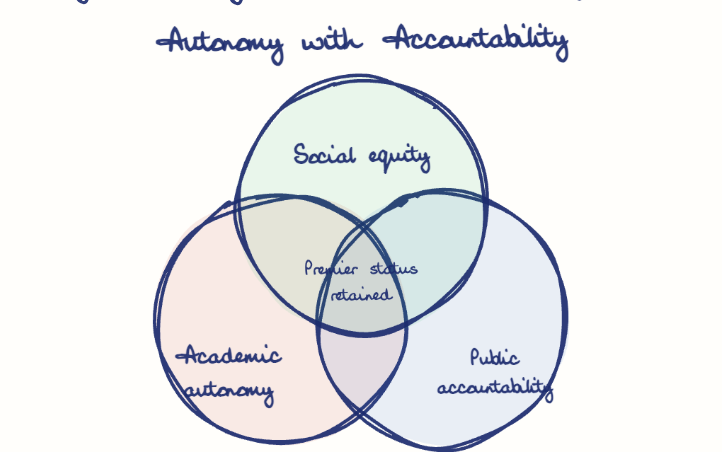
IITs and IIMs should retain premier status and gain freedom over courses and student selection, provided reservation law, affordability and student welfare are safeguarded. The IIM Act, 2017 shows board-led autonomy, while the IIM (Amendment) Act, 2023 partly recentralised it.
Model answer
Ghissu Editorial · Verified 4 Oct 2026 · 264 words
Brand and benchmarking
Premier status attracts faculty and partners, as IIT Madras at Zanzibar (2023) and IIT Delhi at Abu Dhabi (2024) show.
Curriculum agility
AI and semiconductor courses cannot wait for central approval cycles, as the Yashpal Committee (2009) warned against over-regulation.
Selection fit
IITs run JEE Advanced and IIMs run CAT; IIT Madras's online BS in Data Science (2020) uses its own qualifier and widens access.
Equity
Autonomous admission must respect the Central Educational Institutions (Reservation in Admission) Act, 2006 under Article 15(5).
Affordability
HEFA loans (2017) and the 2016 rise in IIT fees to ₹2 lakh a year shift costs to students.
Student well-being
The Supreme Court's National Task Force on student mental health (2025) shows autonomy carries a duty of care.
Recentralisation
The IIM (Amendment) Act, 2023 made the President the Visitor with powers over directors.
This model answer is indicative and the model can make mistakes; please verify key facts independently.
Practise this question
1Get the answer sheet
Sized for this question.
2Write your answer
Timed, by hand.
3Get it marked
Your score and what to fix.
This chapter in the exam
Education9 questions
Asked in 8 of 14 sittings since 2013
- 2026Should education be treated primarily as a welfare obligation of the state or as a strategic investment for building a globally competitive, knowledge-driven nation ? Critically evaluate.
- 2023Skill development programmes have succeeded in increasing human resources supply to various sectors. In the context of the statement analyse the linkages between education, skill and employment.
All 9 questions, sorted by sub-topic, with model answers and practice.
Question from the official UPSC Civil Services (Main) Examination 2014 paper. Answer written by Ghissu's engine and checked against our editorial standards. Found an error? Tell us and we correct it within 48 hours.